Short answer
To migrate from ClickUp to Krokul, connect a personal ClickUp API token, give every list a role (deals, contacts, companies, tasks or skip) and map its custom fields, run a dry run that writes nothing, then import. A list with the deals role becomes a pipeline, its statuses become stages, and a task list can become a project.
- Read from ClickUp: lists with tasks, subtasks, checklists, comments
- Decided by you: a role for every list
- Stays in ClickUp: Goals, Whiteboards, automations
On this page
What transfers when you migrate from ClickUp to Krokul#
ClickUp stores everything as tasks in lists, so a ClickUp migration starts with a decision about each list. The method behind the order is described in the guide on how to switch CRM without losing data.
The ClickUp connector reads through the ClickUp REST API version 2 and has no fixed map of fields, because ClickUp does not know what a deal or a contact is. You give each list a role in the list layout, and the role decides what its tasks become.
| In ClickUp | Becomes in Krokul | What arrives |
|---|---|---|
| A list with the role Deals | A pipeline with its deals | Each task becomes a deal. The list becomes a pipeline named after it, and its statuses become open, won or lost stages. The amount comes from a money field. |
| A list with the role Contacts | Contacts | The task name is the person’s name. Phones and emails come from the custom fields you point to. |
| A list with the role Companies | Client companies | The task name is the company name. A text field Company in another list also creates one company per distinct name. |
| A list with the role Tasks | Tasks, optionally inside a project | Tasks keep the due date, the time estimate, the checklist and the assignee. The status becomes open, done or cancelled. |
| Subtasks | Subtasks | Krokul has one level of subtasks, so a deeper subtask goes under the top task. |
| Comments | Feed events or description text | A comment on a deal, a contact or a company becomes an event in its feed with the author and date in the text. Comments on a task are added to its description. Up to 50 comments per task move. |
Every record keeps its ClickUp ID and the link to its task. Products are not read, so move them from a file. Goals, Whiteboards, automations and access rights stay in ClickUp, and attachments are not transferred. Docs go through the ClickUp Docs import.
How to give each ClickUp list a role in the list layout#
A list layout is the profile in which you give every ClickUp list a role and map its custom fields to Krokul fields. The Migration screen shows it on the Check step, with the lists grouped by space and folder and the task count next to each. Without a layout the import stops with the error “no list layout”.
You can fill the layout by hand or press Draft with the assistant. The assistant sees only the names of lists, statuses and fields and a few sample values, with phones and emails masked, and it only proposes a layout. A person approves it, and the records are written only by the run that you start. Before the start Krokul checks the layout and marks a list or a field with an error.
How ClickUp statuses become deal stages and loss reasons#
A ClickUp status becomes a Krokul stage, and each stage is open, won or lost. A closed status whose name speaks of a win, such as Paid, becomes a won stage, and the other closed statuses become lost stages.
- Several statuses can point to one stage. Set your own stages in the layout, so 16 statuses can become 10 stages.
- A lost stage can carry a loss reason. If the reason does not exist yet, the import creates it.
- An open status such as “on hold” or “waiting” can become a pause until the date in the Contact by field, or for 14 days when that field is empty.
How ClickUp task lists become Krokul projects#
A list with the role Tasks can become a project in Krokul: under Project for the tasks of the list you choose Do not create, From the list or From the folder. The import creates a project named after the list or its folder, and the tasks and subtasks of the list go into it. From the folder exists only for a list that lies in a folder.
This is how a ClickUp list with delivery work turns into a project with tracked hours in Krokul.
In what order does a ClickUp migration run#
A ClickUp migration runs in six steps, and Krokul writes the records in a fixed order: client companies, contacts, products, deals, tasks and then comments, so every deal finds its company and contact already in place. The general list of checks is in the CRM migration checklist.
Count the lists and decide what each one is
Write down every space, folder and list you use, with the number of tasks in each, and note beside each list whether it holds deals, people, companies, ordinary work or nothing for the CRM. These numbers are the totals you compare with at the end.
Prepare the pipeline stages and users in Krokul
Invite the people who own ClickUp tasks, because the import never creates users. A member without a matching user arrives as an empty assignee. Decide which stages you want in the deals pipeline.
Connect ClickUp with a personal API token
In ClickUp open your avatar, then Settings, Apps and API Token, generate a token that starts with pk_ and paste it into the Migration screen, opened as an administrator. Click Check connection. If you have several workspaces, enter the Workspace ID, because by default Krokul takes the first one the token can see.
The server reads the token, and the screen does not show it again after the check. The connector only sends read requests, so nothing changes in ClickUp.
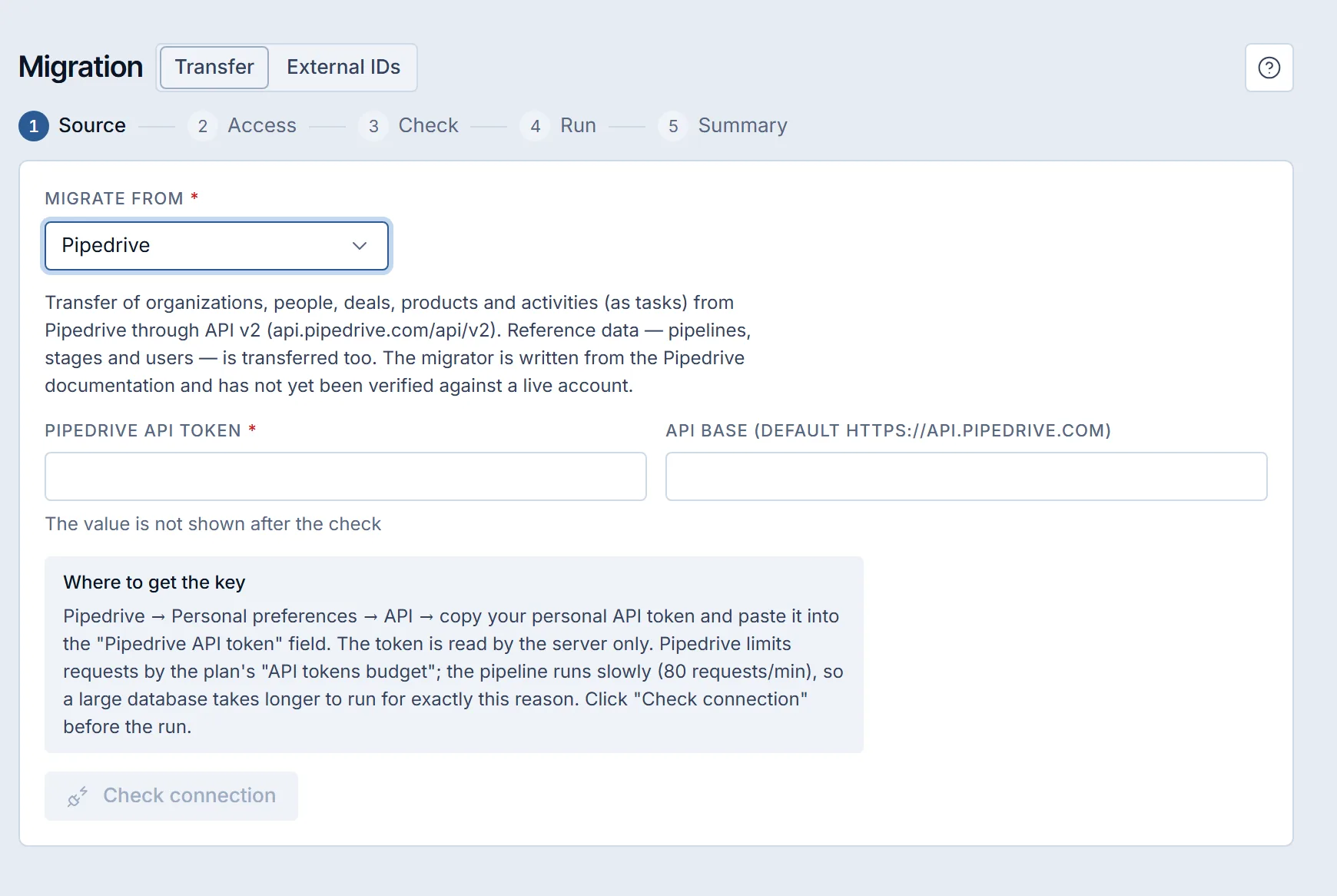
The Source step in a Krokul demo workspace, shown here with Pipedrive chosen. ClickUp is picked from the same list and asks for its own token the same way. Give every list a role and map its fields
On the Check step open the list layout, press Draft with the assistant or fill it by hand, and give each list a role. Then point the custom fields to Krokul fields such as phones, emails, deal amount, close date or a link to a company, set the stages and status rules of the deals list and choose the project for each task list.
Choose whether to transfer comments, subtasks and archived tasks, and pick a default assignee for tasks that have none. The Migration screen has no step for matching ClickUp members with Krokul users, so an implementation partner or an administrator writes that matching through the migration API call migration/api-setMapping.
Run a dry run and read the report
Start the dry run from the Check step. It takes the token from the connection check on the server, reads the lists you included at 90 requests per minute, applies the layout and writes nothing in Krokul.
Repeat it after every change to the layout, until each failing row has a reason you accept and the totals match step 1.
Run the import and check the summary
Start the real run. It works on the server in the fixed order, so you can pause and resume it, or close the page and come back to the summary. The summary lists created, updated and failed rows, with a reason for each failed one.
Compare the totals with step 1, open twenty records chosen at random and compare every field with ClickUp. Keep ClickUp readable until that check passes.
What does a dry run of a ClickUp migration show#
A dry run of a ClickUp migration shows, for each kind of record, how many Krokul records the real run would create, update and skip, and lists the rows that would fail, with the reason. ClickUp reports the task count of a list only as a counter, so the dry run is the first exact count.
| Records | Would be created | Would be updated | Would be skipped |
|---|---|---|---|
| Client companies | 180 | 0 | 12 |
| Contacts | 720 | 0 | 65 |
| Deals | 410 | 0 | 0 |
| Tasks | 1,950 | 0 | 0 |
| Comments (feed events) | 2,300 | 0 | 0 |
In the example nothing would be updated, because no earlier run exists. The skipped column counts duplicates of records already in the workspace and rows that would fail, so check these rows in ClickUp first. Rows that would fail are listed with their reasons.
ClickUp allows 100 requests per minute on a token, and Krokul keeps to 90. Comments need one request per task, so 3,000 tasks with comments take about 35 minutes by the connector’s own estimate, and 1 to 2 minutes without comments.
How to roll back a ClickUp import that landed wrong#
A rollback of a ClickUp import removes the records that this import created and leaves everything else alone. It applies to one run at a time and is available only for a real run.
- Records the run created are removed, with the last kind of record going first.
- Records the run only updated keep their new values, so correct them by hand if needed.
- Records that someone changed after the import stay in place.
- A dry run created nothing, so there is nothing to roll back.
Krokul keeps the ClickUp ID of every record it writes, so a repeated run updates the records that already moved and creates no duplicates.
What was checked on a live ClickUp workspace and what was not#
Contacts, deals, tasks and comments were checked against a live ClickUp workspace. Client companies and fields of the Relationship type were not, because that workspace had no companies list and no such fields. The dry run on your own data is the first real test of them.
Who should run the move: your team or an implementation partner#
A company with a few lists, one deals pipeline and a handful of users can run the move on its own. A business with a running ClickUp workspace, many lists and a team that lives in it gets the layout, the status rules, the user matching and the final check from an implementation partner, who also trains the team.
The page on moving ClickUp data into Krokul lists the sources it reads, what it moves and what it leaves behind. Products and any data that ClickUp does not hold move from a file, as the guide on moving from spreadsheets to a CRM describes.
Which mistakes cost the most when you migrate from ClickUp#
- Treating every list as deals. Contacts, companies and ordinary work then arrive as deals, so give each list its own role and skip the rest.
- Skipping the status rules. The pipeline then repeats every ClickUp status, so set your own stages and loss reasons first.
- Skipping the dry run. The same mapping error repeats on every record, and only a dry run shows it before anything is written.
Frequently asked questions#
How long does a ClickUp migration take?
A workspace of 3,000 tasks with comments takes about 35 minutes by the estimate in the connector hint, and without comments 1 to 2 minutes.
Can the assistant write into my CRM?
No. The assistant only drafts the list layout, and you edit and approve it. The records are written by the run that you start yourself after the dry run.
Who can run a migration in Krokul?
Only an administrator runs a migration. The server reads the token you paste, and the screen does not show it again after the connection check.