Short answer
Days sales outstanding (DSO) is the average number of days a B2B company takes to collect payment after invoicing. Calculate it as accounts receivable at the end of the period, divided by revenue invoiced in the period, multiplied by the days in the period. A lower DSO means cash arrives sooner.
- Formula: receivable ÷ invoiced revenue × days
- Typical period: 90 days
- You need: open invoices and the invoiced total
On this page
When you need to know your DSO#
DSO is the measuring step of getting B2B invoices paid on time. It condenses the whole receivables list into one number that you can track from quarter to quarter.
- Sales look healthy, yet the bank balance is lower than the invoices suggest.
- You changed payment terms or the reminder routine and want proof that it worked.
- Days sales outstanding (DSO)
- Days sales outstanding is the average number of days between issuing an invoice and receiving the money for it, calculated from receivables and invoiced revenue over a period.
- Accounts receivable
- Accounts receivable is the sum of invoices issued and not yet paid on a given date, including invoices that are not yet due.
How to calculate DSO in four steps#
Calculating DSO means comparing the money clients still owe with the money you invoiced, then converting the ratio into days.
Choose the period
Pick a period of 30, 90 or 365 days and keep its length fixed. A 90-day quarter smooths one-off peaks and still reacts to a change within a few months.
Add up the invoices issued in the period
Total every invoice with a document date inside the period, whether paid or not. Leave out drafts and cancelled invoices. Keep all amounts in one currency.
Add up what is unpaid on the last day
Take every invoice issued up to the last day of the period and subtract the payments received up to that day. Sum the remainders, including invoices that are not yet due.
Divide and multiply by the days
Divide the receivable by the invoiced revenue, then multiply by the days in the period. Round to one decimal place.
If the period has no invoiced revenue, DSO does not exist for it, because zero days would read as instant payment.
Tip. Calculate DSO on the same day of the quarter every time, so the numbers compare.
How to calculate DSO on an example#
The example uses three 90-day quarters of one company with Net 30 payment terms.
| Quarter | Receivable at quarter end | Invoiced in quarter | Days | DSO |
|---|---|---|---|---|
| Q1 | £112,000 | £420,000 | 90 | 24.0 |
| Q2 | £189,000 | £450,000 | 90 | 37.8 |
| Q3 | £150,000 | £500,000 | 90 | 27.0 |
DSO = receivable at the end of the period ÷ revenue invoiced in the period × days in the period, so Q2 gives £189,000 ÷ £450,000 × 90 = 37.8 days. Against Net 30 terms, 24.0 days means clients pay inside the term on average, and 37.8 days means payment arrives about eight days after the due date. Q3 recovers to 27.0 days.
How to read DSO and what moves it#
Read DSO against your payment terms and your own history. A DSO well above the terms means late payments pull the average up.
- Late invoicing raises DSO, because the clock for payment starts later.
- A few large overdue invoices raise DSO more than many small ones.
- A quarter with low sales raises DSO even when clients pay at the usual speed, because the same receivable is divided by smaller revenue.
Split the debt into aging buckets by days past due to see which invoices push the number up, then follow the weekly routine for chasing late invoice payments.
Which mistakes distort DSO#
- Mixing period lengths. Compare only values of the same period.
- Adding amounts in different currencies. Convert every invoice into one currency before totalling.
- Leaving out invoices that are not yet due, which belong in receivables.
- Comparing your DSO with another company without comparing payment terms. A Net 60 company and a Net 15 company have different normal values.
How Krokul calculates DSO#
Krokul CRM is a B2B CRM for contract-based companies: deals, projects and profit per client in one system, implemented by integration partners. It calculates DSO with the formula above, from the invoices already stored in the system.
The receivable is the debt on issued invoices minus the payments applied to them on the last day of the period, counted by the same logic as the Debtors screen. The revenue is the sum of invoices that are issued or completed and dated inside the period. Both are totalled in the company’s base currency at the rate frozen on each invoice, and the period defaults to the last 90 days.
A period without invoiced revenue returns no DSO, and the tile says so. The tile sits on the sales dashboard for administrators and managers, because the number covers the whole company. The debt, the revenue and the days behind the number appear under it or behind an info icon, depending on the palette, and a click on the tile opens Debtors.
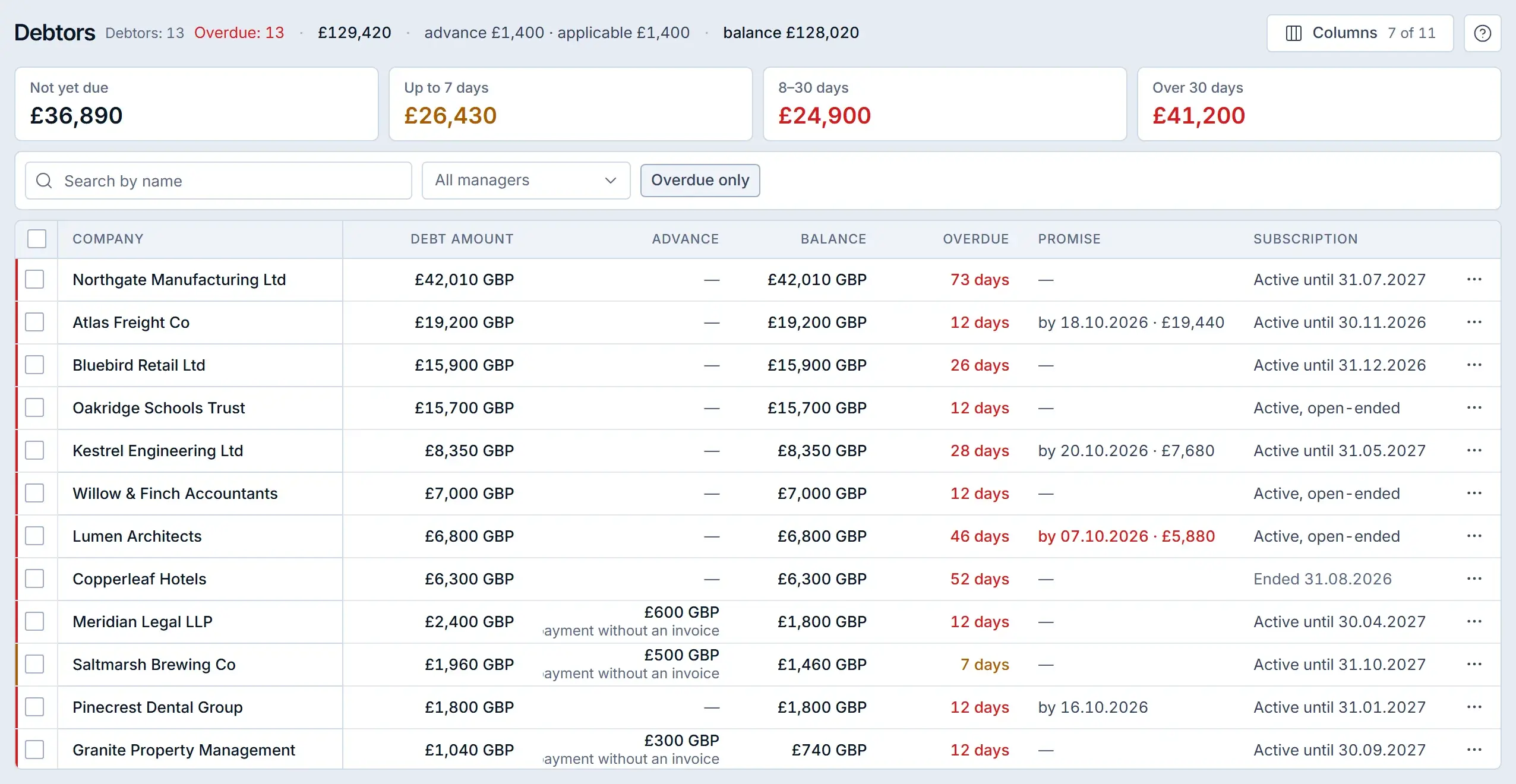
Bank statement matching and payment promises sit next to the Debtors screen in the receivables workflow.
Frequently asked questions#
What does DSO stand for?
DSO stands for Days Sales Outstanding, the number of days of sales that remain unpaid. Finance teams also call it the average collection period.
What is a good DSO?
A good DSO is close to your payment terms. With Net 30 terms, a DSO of 30 to 35 days means clients pay at about the agreed speed, and the trend over several quarters tells you more than a single value.
Is DSO the same as the average payment delay?
No, DSO includes the payment term itself. As a rough reading, subtract your average payment term from DSO to estimate how many days clients pay after the due date.
Which period should I use to calculate DSO?
Use 90 days for a quarterly review. A 30-day period reacts faster and fluctuates more, so use it only when invoicing is regular.