Short answer
To chase late invoice payments, review overdue B2B invoices once a week at a fixed time, oldest debt first. Give each invoice one next action by age (a reminder, a call or an escalation), record every promised date as a task for the account owner, and close the week by comparing the overdue total with last week.
- Rhythm: one review a week
- Order: oldest debt first
- Output: a date and an owner per invoice
On this page
When do you need a weekly routine for late payments?#
You need a weekly routine for late payments when invoices go unpaid and nobody can say who calls the client, and when. The routine is the working core of the guide to getting B2B invoices paid on time, and it turns a list of unpaid invoices into a list of dated actions.
- You learn about an unpaid invoice from the client, a month after the due date.
- Several people call the same client about different invoices in the same week.
- Overdue invoices live in a spreadsheet that one person updates when there is time.
- A client promised to pay, and nobody remembers the date or who heard it.
- The owner asks how much money is late, and the answer takes an afternoon.
- Collection routine
- A collection routine is a fixed weekly sequence of steps for overdue invoices: refresh the list, contact each client, record the result and review the totals.
- Overdue invoice
- An overdue invoice is an issued invoice whose due date has passed and whose amount is not fully paid.
- Roll-forward
- A roll-forward is the overdue total at the end of the week, calculated from the total at the start, the money collected and the invoices that became overdue.
How to chase late invoice payments in six steps#
Chasing late invoice payments works when the same six steps run every week in the same order. The whole routine takes a finance manager about an hour, plus the calls that the account owners make.
Fix the weekday, the hour and the owner of the list
Pick one weekday and one hour, for example Monday at 9:30, and name one person who owns the list. A routine that depends on whoever has time fails in the first busy week.
The finance manager owns the list, and each account owner owns the calls to their own clients.
Refresh the list of overdue invoices
Apply every payment that arrived since the last review to its invoices first. A paid invoice that still shows as debt makes you call a client who has already paid, and that call costs more trust than a late invoice.
Then list each overdue invoice with the client, the unpaid amount, the due date and the days past due.
Sort by days overdue and group by age
Sort the list by days overdue, largest first, so the oldest debt gets the first call. Sorting by amount puts the largest client first by habit, and the invoices that are 60 days late wait another week.
Group the invoices into not yet due, up to 7 days, 8–30 days and over 30 days, as the guide on setting aging buckets describes.
Choose one action for each age
Match the contact to the age. Send a reminder before the due date, resend the invoice in the first week, call in the second to fourth week and move to the contract signer after 30 days.
A reminder that names the invoice number, the amount, the due date and the bank details gets an answer faster than a general message about a debt.
Tip. Contact the person who approves the payment. An assistant who forwards the message does not release the money.
Record every promised date and give it an owner
Each call should end with a calendar day. Write the day, the amount and the person who said it on the client record, and put a task for the account owner on that day.
The guide on recording a promise to pay covers what to do when the date slips.
Close the week with a roll-forward
At the end of the week, calculate the overdue total again and write one line: what was collected, what became overdue, what is the new total. Compare it with last week before the next review.
A falling total means the routine works. A flat total with many broken promises means the calls reach the wrong people.
What does a weekly collection rhythm look like?#
A weekly collection rhythm spreads the routine over five days, so the review, the calls and the escalations each have a slot. The table shows one way to split the week for a team of one finance manager and several account owners.
| Day | Step | Owner | Output |
|---|---|---|---|
| Monday morning | Refresh the list, sort by days overdue, group by age | Finance manager | An ordered list with an action per invoice |
| Monday and Tuesday | Reminders and calls for the first three groups | Account owners | A promised date for each client reached |
| Wednesday | Escalate invoices over 30 days to the contract signer | Head of finance | A payment plan request in writing |
| Thursday | Second call to clients whose promise falls this week | Account owners | Kept or broken, with a new date |
| Friday | Roll-forward and one line of notes | Finance manager | This week against last week |
How to prioritise overdue invoices on an example#
To prioritise overdue invoices, order them by days overdue and attach to each the next action for its age. The example uses five clients on a Monday review.
| Client | Unpaid | Days overdue | Promise | Action this week |
|---|---|---|---|---|
| Client A | £42,000 | 73 | none | Contract signer calls, payment plan in writing |
| Client B | £6,800 | 46 | broken | Call Monday, record a new date |
| Client D | £7,000 | 12 | none | Resend the invoice, ask who approves it |
| Client C | £19,200 | 12 | Friday | Check the bank on Friday morning |
| Client E | £1,800 | 5 | none | Send a reminder with the invoice attached |
The overdue total is £42,000 + £6,800 + £7,000 + £19,200 + £1,800 = £76,800. Client A is only 55% of the money but takes the longest call, and Client C needs no call at all until Friday.
| Line | Amount |
|---|---|
| Overdue at the start of the week | £76,800 |
| Collected during the week (Client C paid on Friday) | −£19,200 |
| Became overdue during the week | +£5,400 |
| Overdue at the end of the week | £63,000 |
Closing overdue = opening overdue − collected + newly overdue, so £76,800 − £19,200 + £5,400 = £63,000. The team collected £19,200 ÷ £76,800 × 100 = 25% of the opening overdue total, and the next review starts from £63,000.
Which mistakes make late-payment chasing fail?#
- Chasing only when cash runs short. The calls start late and the client hears panic; run the review every week, whatever the bank balance.
- Sorting by amount. The largest client gets the call by habit while a 60-day invoice waits; sort by days overdue.
- Calling without applying the latest payments. The client has paid, you lose credibility; refresh the list first.
- Letting every account owner use a different wording. Clients learn which reminders to ignore; agree one short template.
- Ending a call without a date. Nothing triggers the next check; keep asking until the client names a calendar day.
A weekly chasing checklist to copy#
- Apply the payments received since the last review.
- List overdue invoices with unpaid amount, due date and days past due.
- Sort by days overdue and group by age.
- Write one action and one owner next to each invoice.
- Send reminders and make the first calls before Wednesday.
- Escalate invoices over 30 days to the contract signer.
- Record each promised date and set a task for the account owner.
- Check the promises that fall due this week.
- Calculate the roll-forward and write one line of notes.
What should a payment reminder say?#
A payment reminder should state the invoice number, the amount, the due date and the way to pay, and ask for one thing, the date of payment. Copy the lines below into your own template and adjust the tone to the client.
- Subject line: Invoice number, amount and the word “reminder”.
- Opening: the invoice number, the amount and the due date in one sentence.
- Request: “Please confirm the date when the payment will reach our account.”
- Attachment: the invoice again, so the accountant does not search for it.
- Closing: your name and a direct phone number.
Once the manual routine runs smoothly, the first reminder is the step that is easiest to hand to a machine. The guide on automating overdue payment reminders describes that step.
How to run the weekly routine in Krokul#
Krokul CRM is a B2B CRM for contract-based companies: deals, projects and profit per client in one system, implemented by integration partners. The Debtors screen holds the overdue list for steps two to five, and the page on payments and debtors in Krokul shows how it connects to invoices and bank payments.
Debt on the screen is the issued invoices minus the payments applied to them. The screen opens with the Overdue only filter on, so the first rows are clients whose due date has passed. The table opens sorted by debt amount, and the Overdue column header sorts it by days overdue. In the standard palette four tiles above the table total the age groups, and in the branded Krokul palette the same groups are buttons in the filter bar.
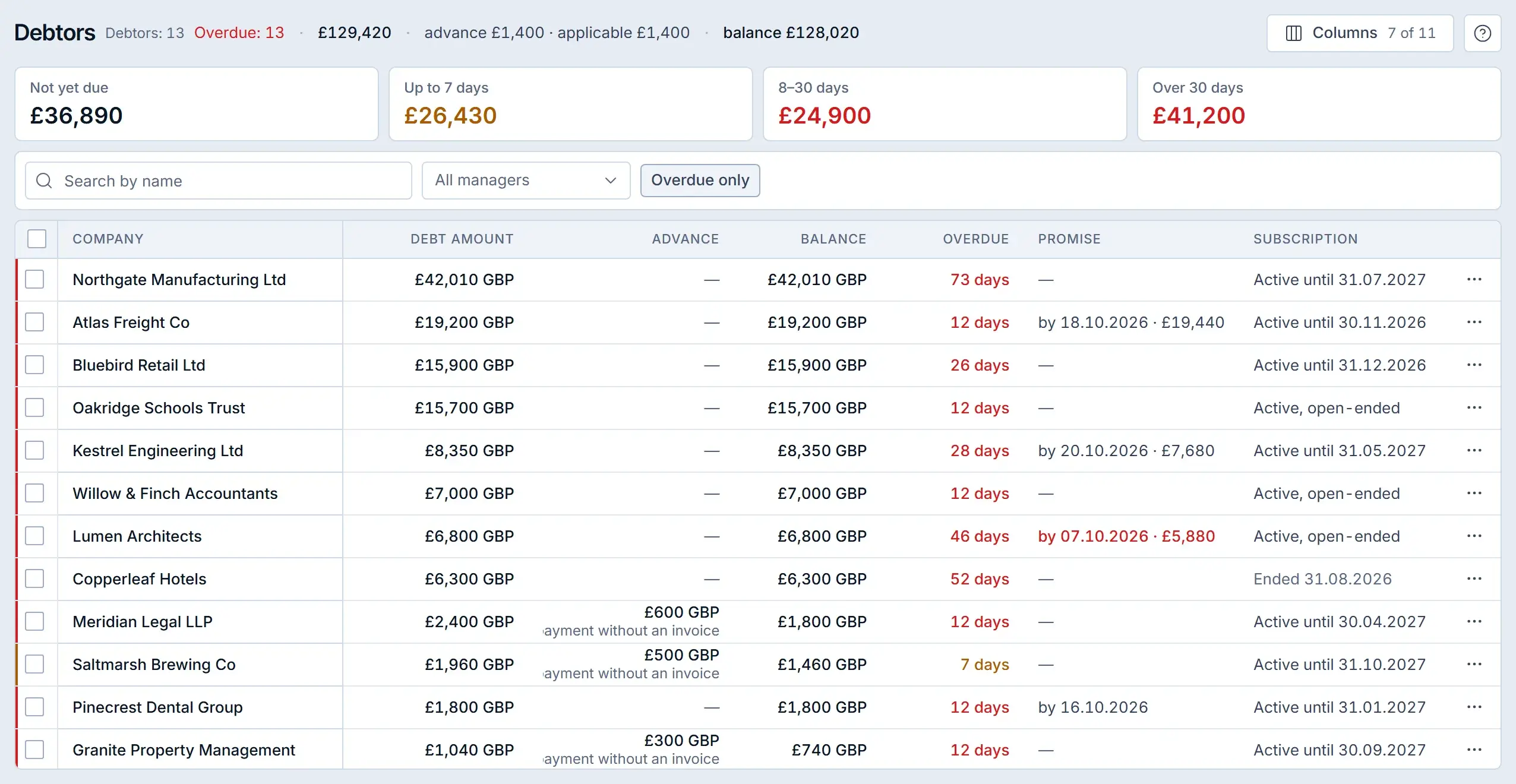
The row menu of each client has Invoices, Payment promise and Task for manager. To give a task to many account owners at once, tick the rows and use the Task for manager action for the selected rows. Krokul creates a reminder task for each client’s account owner, skips a client who already has an open task with the same title and tells you how many were skipped. A client with no account owner gets a task without an assignee.
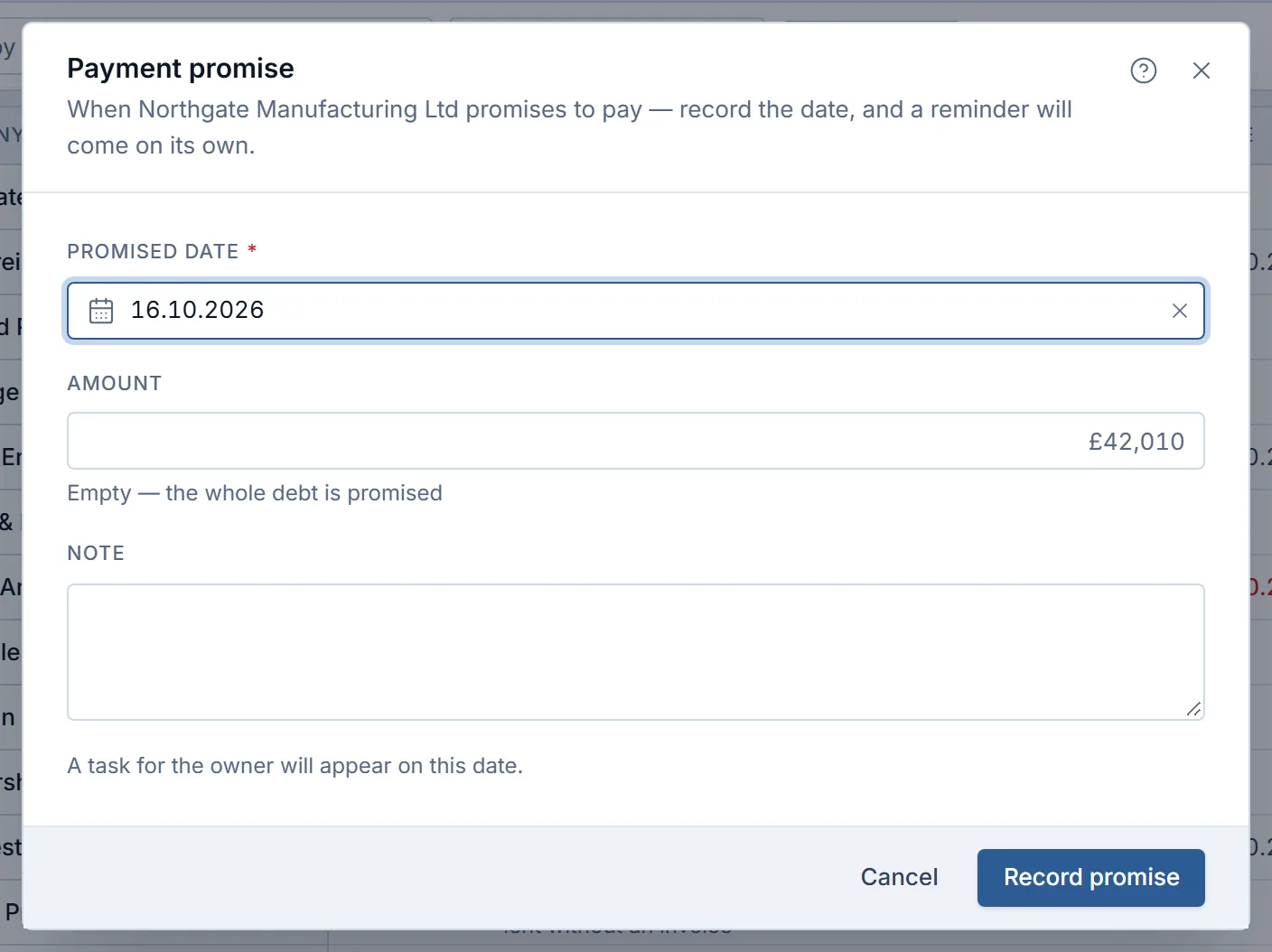
The payment promise dialog takes the promised date, an optional amount and a note. An empty amount means the whole debt is promised, and a date in the past is rejected. Krokul saves the promise in the client feed with its author and creates a task for the account owner on the promised day. The Promise column then shows the latest promise, and ready-made filters list clients with a broken promise, a promise due today or an overdue invoice and no promise at all.
Frequently asked questions#
How often should I chase a late invoice?
Chase it once a week in the routine, and add a call on the day a promise breaks. A reminder before the due date and one in the first week after it are enough before the weekly calls begin.
Who should chase late payments in a small company?
The account owner makes the call, and one finance person owns the weekly list. The client talks to the person it knows, and the list keeps every overdue invoice in front of someone.
When should I stop work for a client who does not pay?
Pause new work after the third missed promise or when the invoice is over 60 days late, and confirm the pause in writing. Check the contract first, because the payment terms there set what you may do.
Can I charge interest on late payments?
Only when the contract or the law of your country allows it, so check both before you add a charge. Many companies state the interest in the contract and still waive it for clients who pay within a week of a reminder.