Short answer
To record a promise to pay, save the date the client named, the amount (leave it empty for the whole debt) and who gave the promise on the client record, then set a task for the account owner on that date. When the date passes without payment, call the same day, record the new date and escalate after the second miss.
- Record: date, amount, who said it
- Check: on the promised day
- Escalate: after the second miss
On this page
When should you record a promise to pay?#
Record a promise to pay every time a client names a date for an overdue invoice, in a call, a meeting or an email. A promise belongs to the weekly routine in the guide to getting B2B invoices paid on time, and it gives the next call a date instead of a feeling.
- The accountant of the client says the payment run is on Thursday.
- The client agrees to pay part of the debt now and the rest next month.
- A disputed invoice is settled and the client names a payment date.
- The client asks for an extension and you agree to a new date.
- A debt in the 8–30 day group has no date at all, and the call ends with one.
- Promise to pay
- A promise to pay is a payment date, and often an amount, that a client names for an unpaid invoice. It is a statement from the client, with no legal force of its own.
- Broken promise
- A broken promise is a promise to pay whose date has passed while the invoice is still unpaid.
How to record a promise to pay and follow it up#
The method has five steps, from the call to the escalation. Each step is short, and the whole routine takes a few minutes per client.
Ask for a date and an amount in the same call
Ask “which day will the money be in your account?” and “for the whole invoice or part of it?”. A date such as “after the 15th” is not a date, so ask until you hear a calendar day.
Confirm the date back to the client in one sentence, so both sides leave the call with the same day.
Write the promise on the client record the same day
Store the promised date, the amount, the person who gave it and the channel. A promise that lives in a mailbox or in your head is lost when the person who heard it is away.
Leave the amount empty when the client promises the whole debt, and record a number only for a partial payment.
Tip. Never record a date in the past. If the client says “it was paid last week”, check the bank statement and apply the payment instead.
Set a reminder for the account owner on the promised day
The person who owns the client relationship checks the promise, because the client answers that person. Put a task on the promised day with the client and the date in its title, and the amount and invoice numbers in the note.
Check the bank on the promised day
Open the incoming payments in the morning and look for the amount. When the money is there, apply it to the invoice and close the task. When it is not, move to the next step before the end of the day.
Call the same day when the promise slips and record the new date
Call on the day the promise breaks, because the next day the client has already forgotten about it. Ask what happened, agree a new date and record it next to the old one, so the history shows every date the client gave.
Escalate after the second miss: move the conversation to the person who signed the contract and agree a payment plan for the full amount.
What to do when a client misses the promised date#
When a client misses the promised date, call the same day, record a new date and increase the level of the contact with every miss. The first miss is usually an accounting delay, and the second one says that the invoice has no priority on the client side. The guide to chasing late invoice payments describes the weekly rhythm that these calls belong to.
| Misses | What it usually means | Action |
|---|---|---|
| 0, date is tomorrow | The payment is scheduled | Send a short reminder with the invoice attached |
| 1 | Accounting delay or a missing approval | Call the same day, ask who approves, record a new date |
| 2 | Low priority on the client side | Call the contract signer and ask for a payment plan |
| 3 or more | Dispute or cash shortage | Pause new work and confirm the plan in writing |
Group the debt by age first. A promise on an invoice that is 45 days overdue needs a faster escalation than a promise on an invoice that is 5 days overdue. The method for setting aging buckets shows how to split the groups.
How to measure whether promises can be trusted#
Promise reliability is the share of promises that arrived on the promised day: promises kept ÷ promises made × 100. The number tells you which clients to plan around and which to call a day earlier.
| Promise | Promised date | Amount | Paid on | Result |
|---|---|---|---|---|
| 1 | 10 Oct | £5,000 | 10 Oct | Kept |
| 2 | 24 Oct | £8,000 | 31 Oct | Broken by 7 days |
| 3 | 31 Oct | £8,000 | 2 Nov | Broken by 2 days |
| 4 | 15 Nov | £3,000 | 15 Nov | Kept |
This client kept 2 of 4 promises, so reliability is 2 ÷ 4 × 100 = 50 %. Both broken promises were paid within a week, which shows a slow approval chain and no refusal to pay. Plan this client’s cash a week after the date the client gives you.
Which mistakes make a promise to pay useless?#
- Accepting “soon” or “next week”. The record has no date, so nothing triggers a check; keep asking until the client names a calendar day.
- Keeping the promise in an email thread. Nobody sees it on the day it breaks; write it on the client record the same day.
- Replacing the old date with the new one. The history disappears and reliability cannot be measured; keep every date.
- Checking the promise on the next Monday. By then the client has moved on; check on the promised day.
- Recording a promise made to an assistant who does not pay. Ask who approves the payment and record that name in the note.
A checklist to copy for every promise#
- Client and invoice numbers.
- Promised date as a calendar day.
- Amount, or “whole debt”.
- Who gave the promise, and by which channel.
- Account owner who checks the promise.
- Reminder set for the promised day.
- What happens at the first miss and at the second miss.
How to record a promise to pay in Krokul#
Krokul CRM is a B2B CRM for contract-based companies: deals, projects and profit per client in one system, implemented by integration partners. The Debtors screen has a promise action in the menu of each row, and the page on getting clients to pay shows how the screen fits the rest of the deal.
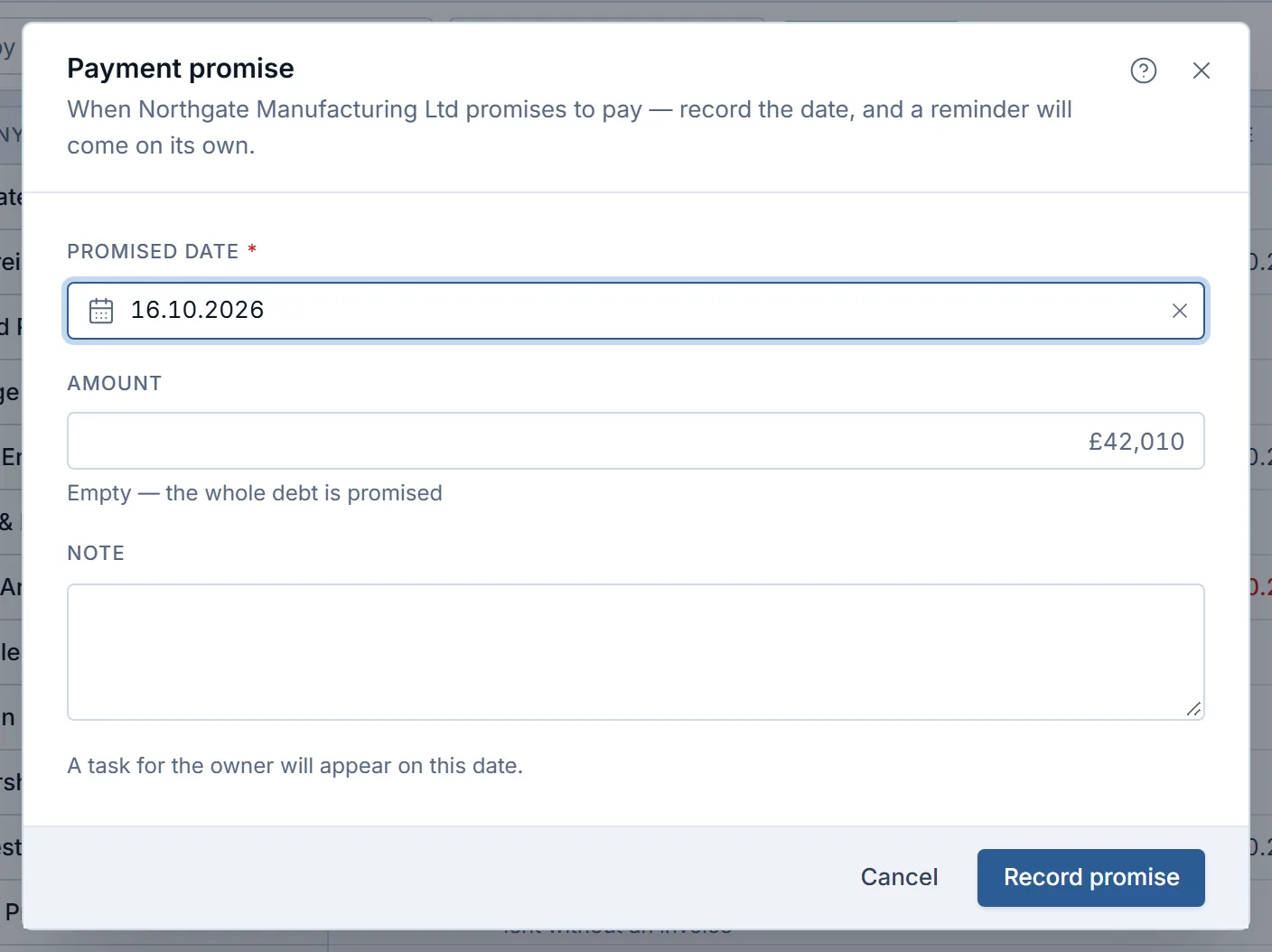
The promise dialog asks for the promised date, an optional amount and a note. An empty amount means the whole debt is promised, and a date in the past is rejected. Krokul saves the promise as an event in the client feed, with the author, and creates a task for the account owner on the promised day. When the client has no owner, the task is unassigned and stays in the shared task list.
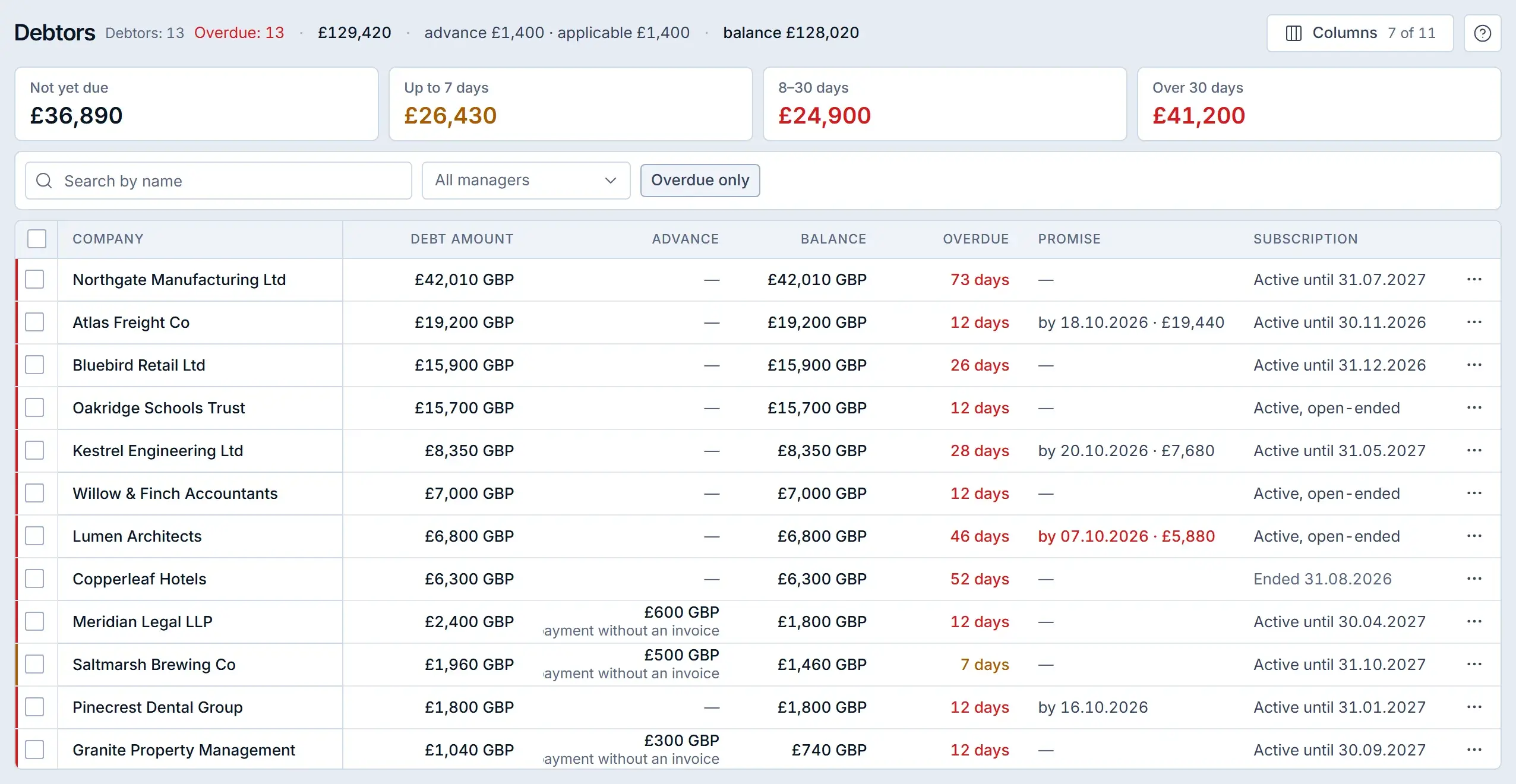
The Promise column of the Debtors list shows the latest promise with its date and amount, and a date that has passed turns red. The older promises stay in the client feed. Filters show clients with a broken promise, clients whose promise falls today and overdue clients with no promise at all, which is the shortest list for Friday calls.
Frequently asked questions#
Is a promise to pay legally binding?
A promise to pay is a statement of intent and does not change the contract. The payment term in the contract and the invoice remain the legal basis, so keep the promise as a working record and confirm important changes in writing.
Should I confirm a promise to pay by email?
Yes, confirm it with one sentence that names the amount and the date. A written confirmation removes arguments about what was said and gives you a record to point to when the date passes.
How many promises should I accept from one client?
Accept the first two and escalate on the third. After two misses, move the conversation to the person who signed the contract and agree a payment plan for the full amount.
What is the difference between a promise to pay and a payment plan?
A promise to pay is one date for one payment, and a payment plan is a schedule of several dates and amounts for the whole debt. Use a plan when a client cannot pay at once.