Short answer
A sales commission scheme is a written rule that says what a rep is paid for and how much. Choose the base (deal amount, margin or received payment), the moment it counts, the rate or tiers, a cap and what happens on a refund, then show the rep the monthly calculation so they can check it.
- Choose: base, moment, tiers, cap, reversal
- Check: rep sees own monthly number
On this page
When do you need a written commission scheme?#
- Reps ask how their bonus was calculated and the answer lives in a spreadsheet that one person owns.
- A client pays late or returns an order and nobody knows whether the commission on it was paid.
- Two reps with the same sales get different bonuses because the rule changes from month to month.
- A head of sales wants to push the team towards margin or paid invoices, and the bonus does not follow.
A commission scheme sits next to the plan of the team in a B2B sales pipeline that predicts revenue. Partners who bring deals follow a different logic, which the guide on partner commission models covers.
How to set up a sales commission scheme in six steps#
Choose what the percentage is taken from
The base decides what the rep is rewarded for. A percentage of the deal amount rewards closing, a percentage of the deal margin rewards profitable closing, and a percentage of the received payment rewards money in the bank. Choose the base your business needs most. A company with long payment terms usually starts with received payments.
Margin works only where the cost of the items is known. A deal without a purchase price in its items has a margin base of zero, so check the cost data before you choose it.
Decide the moment the commission is earned
A deal amount counts in the month the deal is won, and a payment counts in the month the money arrived. Write this down in the scheme, because it settles the usual argument about which month a sale belongs to. With payments as the base, every payment is its own event, so a client who pays in three instalments produces three accruals.
Set the rates as tiers
A flat rate gives the same percentage for the first and the thousandth sale. Tiers raise the rate with the volume, for example 3% up to a first threshold, 5% up to a second and 7% above it. Decide whether each tier applies only to its own slice of the base (progressive) or whether the rate of the highest tier reached applies to the whole base. A progressive scale is gentler on the budget and removes the cliff at each threshold.
Tiers can also follow the percentage of the personal plan reached: nothing below 70% of the plan, 3% from 70%, 5% from 100%. The plan itself has to exist for the month, otherwise the accrual is zero, so set it first as described in how to set a monthly sales plan and track plan against actual.
Put a cap on the month
A cap is the largest commission one person can earn in a month. It protects the budget from one exceptional deal. Leave the cap empty when you want no ceiling, and mark in the report who reached it, so the rep understands why the number stopped growing.
Write the reversal rule for refunds
A payment can be returned or a deal can stop being won after the month is closed. Choose in advance what happens: remove the whole accrual for the deal, remove exactly the part that fell away, or leave what was paid as paid. The proportional rule suits most teams. The reversal appears as a negative line in the next open month, so closed months stay unchanged.
Give the rep the calculation and close the period
A scheme that only the head of sales can see keeps the spreadsheet argument alive. Let each rep see their own base, accrual, reversal and total during the month, and close the period when the numbers are agreed. A closed month keeps its numbers. A later change to a deal, a payment or the scheme does not rewrite it, and only the last closed month can be reopened, by an administrator.
How is commission calculated on a progressive scale?#
The table uses a progressive scale on received payments: 3% on the first £500,000 of the month, 5% on the next £500,000 and 7% on everything above £1,000,000. The numbers are an example.
| Rep | Received payments | Slice at 3% | Slice at 5% | Slice at 7% | Commission |
|---|---|---|---|---|---|
| Rep A | £300,000 | £9,000 | £0 | £0 | £9,000 |
| Rep B | £640,000 | £15,000 | £7,000 | £0 | £22,000 |
| Rep C | £1,200,000 | £15,000 | £25,000 | £14,000 | £54,000 |
Commission of a slice = slice of the base × rate of its tier. Rep C has received £1,200,000, which gives £15,000 + £25,000 + £14,000 = £54,000, an effective rate of 4.5%. With a flat rate of 7% on the whole base, the same rep would earn £84,000, which is why the choice between progressive and flat matters.
Which mistakes make a commission scheme unfair?#
- Rewarding the deal amount when the payment never comes. Reps then close deals that do not pay, so reward received payments or margin where payment risk is real.
- Changing the scheme mid-month. Reps stop trusting the number, so change a scheme for the next month and keep the old one for the periods it served.
- Leaving refunds out. The company pays commission on money it gave back, so write the reversal rule before the first month.
- Paying on deals without an owner. A deal with no responsible person belongs to nobody, so assign the owner before the win.
- Hiding the calculation. The rep asks the head of sales for the number each month, so show it to the rep.
What should a commission scheme checklist cover?#
- The base is written: deal amount, margin or received payment.
- The moment the commission counts is written.
- The tiers have a first threshold at zero and rates between 0% and 100%.
- The scale is progressive or flat, by a conscious choice.
- The cap and the reversal rule are written.
- Every rep can see their own monthly number.
- The period is closed with the numbers agreed.
How do sales commissions work in Krokul?#
Krokul CRM is a B2B CRM for contract-based companies: deals, projects and profit per client in one system, implemented by integration partners. An administrator creates the scheme on the Commission schemes screen with the three bases above, tiers of up to twelve steps, a scale in money or in the percentage of the plan, a cap and one of the three reversal rules. A scheme created in the app starts inactive, and only one scheme is active at a time.
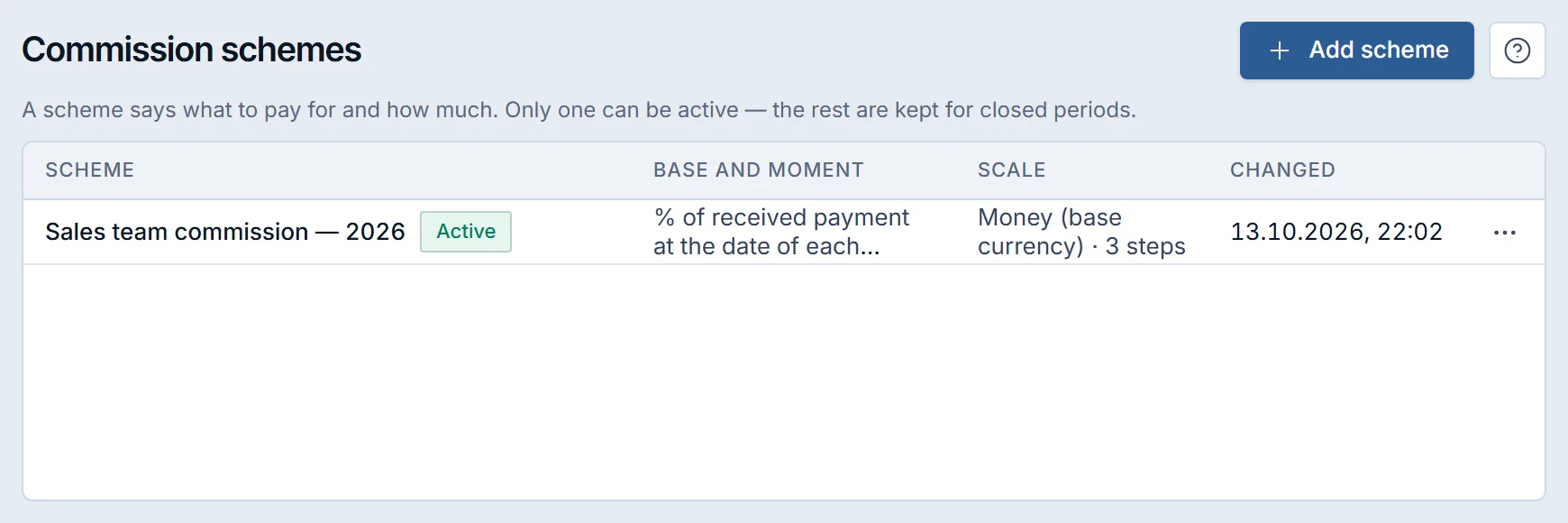
The commission goes to the person responsible for the deal, who is set on the deal card, and a deal without a responsible person produces no accrual. Administrators and managers see the base and the accrual of every person for a month and close the period. The reports name the events that produced nothing, with the reason and the count. Other roles see only their own commission, and every user finds it in the profile, with the base, the accrual, the reversal and the total. Krokul has no paid status: payment happens outside the system.
The page on sales commissions calculated from the same payments shows how the scheme, the payments and the closed period work together.
Frequently asked questions#
Which base is best for a sales commission?
The one that matches your risk. Deal amount rewards closing, margin rewards profit and received payment rewards cash. Companies with late payers move to received payments or margin.
Should commission tiers be progressive?
Usually yes. A progressive scale applies each rate only to its own slice of the base, so there is no cliff at a threshold. A flat scale applies the rate of the highest tier reached to the whole base and costs more.
What happens to commission when a client returns a payment?
It depends on the reversal rule you wrote. The rule can remove the whole accrual, only the part that fell away, or nothing. The proportional rule is the usual default.
Can a rep see the commission of colleagues?
In Krokul they cannot. Roles other than administrator and manager see only their own commission, so the pay of one rep stays private from the others.