Short answer
IT integrators earn recurring revenue from CRM implementations by adding two streams to the one-time implementation fee: a monthly share of each client’s subscription for as long as they manage the account, and paid managed services after go-live. A partner program adds deal registration, which protects the client, and routing, which sends inquiries to certified partners.
- Revenue streams: three
- Review: once a month
- You need: a vendor with public partner terms
On this page
Why one-time implementation fees leave integrators with uneven income#
An implementation project pays when it ends. Between projects the team has nothing to invoice, and the months after a quiet quarter are spent on proposals instead of delivery. Recurring revenue fills those gaps because it arrives every month from clients who are already live.
Three things make recurring revenue possible in a CRM practice. The vendor shares part of the subscription with the partner who manages the client. The partner invoices support and improvements on a monthly cycle. And the client stays with the partner because the partner knows the setup. The sections below cover each part, from pricing the first project to the rules of a partner program.
- Recurring revenue
- Recurring revenue is income that arrives every month from the same clients without a new sale, such as a revenue share or a support retainer.
- Revenue share
- A revenue share is a percentage of the client’s subscription that the vendor pays to the partner who manages that client.
- Deal registration
- Deal registration is the partner’s notice to the vendor that a specific client is being pursued, which protects that client from other partners for a set period.
- Managed CRM services
- Managed CRM services are the paid, ongoing work an integrator performs after go-live: administration, changes, training and monitoring.
- Clawback
- A clawback is the reversal of a commission that was already counted, usually because the client’s payment was refunded.
Which three revenue streams make up a CRM implementation practice#
Krokul CRM is a B2B CRM for contract-based companies: deals, projects and profit per client in one system, implemented by integration partners. The public Krokul partner program is a useful reference for how the three streams fit together, and the next sections use it as the worked example.
Each stream has a different rhythm. The implementation fee is large and arrives once. The subscription share is small and arrives every month for as long as the client stays. The managed services retainer sits between them and depends on how much change the client needs. Together they turn a project business into a base of monthly income with projects on top.
| Stream | How it is earned | Year 1 per client | From year 2 per client |
|---|---|---|---|
| Implementation fee | One project at an agreed price | $3,000 | $0 |
| Subscription share | 25% of a $400 monthly subscription, 12 months | $1,200 | $1,200 |
| Managed services | $300 monthly retainer, 12 months | $3,600 | $3,600 |
| Total | Sum of the three streams | $7,800 | $4,800 |
Formula: annual revenue per client = implementation fee in year 1 + 12 × (subscription × share + retainer). With 20 live clients the recurring part from year 2 is 20 × $4,800 = $96,000 a year, or $8,000 every month, before any new project. The example ignores the waiting rule for the first month described in the commission section and assumes the client stays.
How to build recurring revenue in six steps#
A partner practice reaches a steady monthly base by repeating the same six steps for every client. The order matters, because each step protects the revenue created by the one before it.
Choose a vendor with public partner terms
Read the partner terms before the first project: the share rate, how long it lasts, who owns the client relationship and what the vendor does not do itself. Terms that apply to every partner in the same way let you plan a year of income.
Check three points in writing: the rate cannot fall during the program, the client pays one public price whether or not a partner is involved, and the services you invoice stay entirely yours.
Use the product in your own company first
Run your own deals, projects and hours in the system before you recommend it. The first implementation is then a setup you have already lived with, and your estimates for pipelines, fields and documents come from experience.
Register the deal before the first workshop
Send the registration the day the client agrees to talk, with the company name, contact details and the expected amount. The protection period starts from that day, so a competing partner cannot claim the same client while your discovery work is running.
Price and plan the project in phases
Estimate hours by phase, add a buffer, and agree the exit check for each phase with the client. A phased plan gives you invoices at milestones and a visible end to the project, which is the moment to offer ongoing support.
Offer managed services before go-live
Agree the monthly retainer while the client is still enthusiastic about the project. Define what it covers, how many hours it includes and what happens when the client needs more, so the first support month starts without a negotiation.
Review shares and payouts every month
Once a month, compare the vendor’s statement with your own client list: which clients are active, which payments arrived and which were refunded. A statement you reconcile monthly shows a churned client or a refund while you can still act on it.
Tip. Keep one client list with the plan, the go-live date and the retainer for each account. Every monthly review starts from that list.
How to price CRM implementation services#
CRM implementation pricing works best as hours per phase multiplied by one hourly rate, plus a buffer for change requests. The detailed method is in the guide on pricing CRM implementation services. The model you choose decides who carries the risk of a larger scope.
| Model | Best when | Who carries the scope risk | Invoicing |
|---|---|---|---|
| Fixed price per package | The client’s process is standard and the scope is short | The integrator | Half at start, half at go-live |
| Time and materials | Requirements are open or the client changes them often | The client | Monthly, from logged hours |
| Fixed phases | The project has clear stages and several decision makers | Shared | At the end of each phase |
| Fixed price plus change requests | The core scope is clear and extras are likely | Shared | Package price, then extras by hours |
| Phase | Hours | Amount at $80 per hour |
|---|---|---|
| Discovery and process mapping | 16 | $1,280 |
| Pipelines, fields and roles | 24 | $1,920 |
| Data migration | 24 | $1,920 |
| Integrations and documents | 20 | $1,600 |
| Training and pilot | 12 | $960 |
| Go-live support | 8 | $640 |
| Subtotal, 104 hours | 104 | $8,320 |
| Buffer for changes, 10% | 10 | $832 |
| Project price | 114 | $9,152 |
Formula: project price = (sum of phase hours × hourly rate) × (1 + buffer). Say in the proposal what the buffer covers. A client who sees the estimate by phase accepts the price more easily than a client who sees one total.
What a CRM implementation plan contains#
A CRM implementation plan lists six phases, each with an output and an exit check that the client signs off. The guide on the CRM implementation checklist turns the table below into a copyable checklist.
| Phase | Output | Exit check |
|---|---|---|
| 1. Discovery | Process map, list of pipelines, roles and documents | The client confirms the map in writing |
| 2. Design | Stages, fields, access roles and automation rules on paper | Each rule has an owner |
| 3. Data migration | Companies, contacts and deals loaded after a trial run | Record counts match the source file |
| 4. Integrations and documents | Email, payment services and print templates connected | One test invoice and one test email |
| 5. Training and pilot | Team trained and one team working live | The pilot team enters data for one week |
| 6. Go-live and support | All users live, retainer starts | First monthly review is scheduled |
Data migration can change the schedule when the source data is untidy, so run a trial first. The data migration in Krokul has a trial run that reports how many records would be created, updated and skipped for each entity and lists the rows that would fail with the reason. The trial does not run the full record validation, so the live import can still fail on rows the trial let through. Treat the trial as the first filter, and keep the source file until the live import is checked.
Clients with a simple setup can start on their own. A client with existing data, several pipelines or accounting exchange is where a partner earns the implementation fee, because mapping fields, deduplicating records and configuring stage gates takes judgement that a wizard cannot supply.
How managed CRM services create recurring revenue after go-live#
Managed CRM services turn the end of a project into a monthly contract: the partner keeps administering and improving the system for a fixed fee or an hours package. The guide on managed CRM services covers packaging in detail.
- An hours package for changes: new fields, pipeline edits, new print templates and new automation rules.
- A monthly review of the pipeline, the data quality and the open tasks, with a short written summary.
- Training for new employees when the client hires.
- Monitoring of integrations, such as email, payment services and the accounting exchange, with a fix inside an agreed time.
- An annual review that proposes the next improvements as a priced mini-project.
The partner invoices these services directly, at its own price, and under the public terms of the program the vendor takes nothing from them. When the partner runs its own support hours in the integrator workspace in Krokul, the project shows the hours logged against the client’s package and the price of any overage before the invoice goes out.
Price the retainer by the work the client actually uses. A package of hours with a monthly review keeps the client’s expectations realistic, and unused hours give you a reason to propose the next improvement.
Which partner commission models exist: revenue share, cash basis and clawbacks#
A partner commission is paid in one of four models, and the model decides how predictable the income is. The guide on partner commission models compares them in depth.
| Model | How it pays | Predictability for the partner | Main risk |
|---|---|---|---|
| One-time referral fee | A fixed amount when the client signs | Low, no income after the first month | The partner has no reason to stay involved |
| Percentage of the first year | Share of the subscription for twelve months | Medium | Income ends at the anniversary |
| Ongoing revenue share | Share of the subscription while the partner manages the client | High | The share depends on the partner keeping the account |
| Tiered share | The rate rises with the number of retained clients | High for large partners | Rules that change when the partner is close to a tier |
Two accounting rules matter more than the rate. A cash basis counts a commission only when the client has actually paid, so an unpaid invoice produces nothing. A clawback reverses the commission when the payment is refunded, so the partner does not keep money the vendor returned. A program that states both rules in advance prevents disputes at month end.
The Krokul partner program pays an ongoing revenue share of 25% of the client’s subscription every month while the partner manages the client. The base rate does not drop, program rules change only in the partner’s favor, and any tier rates can only be added on top, no earlier than 12 months after the program starts. The share is counted from the client’s payments, so it follows the cash basis.
- The first month is counted together with the second. After the client pays for the second month, the partner receives the share for both months.
- A month is 30 days from the day of the payment. An annual payment therefore produces months that start every 30 days.
- A refund reduces the net amount of the payment and removes months from the end of the period, so a reversal appears as a negative line in the share ledger.
- The rate of a recorded month is fixed. A later change of the program rate applies to new months only.
- The share lasts while the partner has access to the client’s workspace and the client has not revoked it. A long period without logins does not stop it.
The vendor side keeps a monthly statement per partner and records the payout for the month. The partner sees its own statement in the partner cabinet, next to the list of its clients and the share for each. Services stay outside the statement because the partner invoices them itself.
How deal registration protects the client relationship#
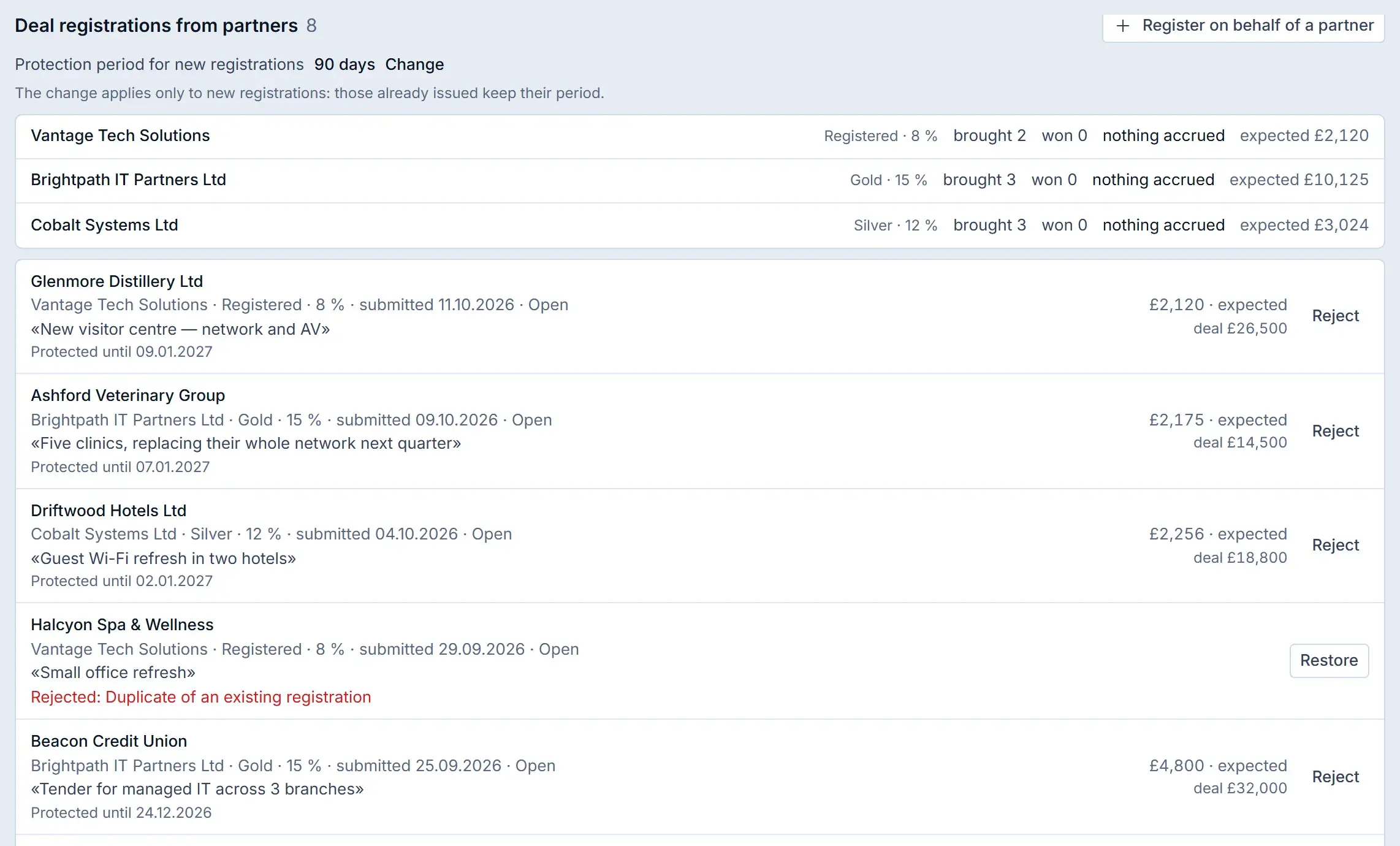
Deal registration protects a client for a fixed period after a partner registers it, so two partners do not spend weeks on the same account. The guide on a deal registration policy for small vendors includes a template. A good policy answers eight questions before the first partner joins.
- Who may register: only certified partners, or any partner with an agreement.
- Which fields are required: company name, website domain, email, phone, contact person and expected amount.
- How a duplicate is found: by domain, email and phone, so a small spelling difference in the company name does not hide a conflict.
- How long protection lasts, counted from the registration date.
- What happens on a conflict: the first active registration holds the client until its date passes.
- Who approves or rejects a registration, and that a rejection carries a written reason.
- What happens at expiry: the client opens for a new registration, and the old record stays with its partner.
- How a partner extends protection when the sales cycle is longer than the period.
In Krokul, a partner registers a deal from its cabinet with the company details and the expected amount. The system checks the domain, the email and the phone against earlier registrations and existing clients, and it reports a conflict only while another partner’s protection is still active. Protection lasts 90 days by default, and the vendor can set any period from 1 to 730 days. A change of the period applies to new registrations only.
How to route inquiries to partners by region and industry#
Routing sends each inquiry that needs an implementation to one partner at a time, using region, industry and partner standing. The guide on routing inquiries to partners describes the setup. Write the order of the rules down first, because partners accept routing only when they can predict it.
| Order | Rule | Why it comes in this position |
|---|---|---|
| 1 | Partner is certified | The vendor guarantees a trained team to the client |
| 2 | Region matches | Travel to another city raises the cost of implementation |
| 3 | Industry matches | Experience in the client’s industry shortens discovery |
| 4 | Partner tier | Higher tiers receive the queue first |
| 5 | Client retention | Partners who keep clients longer move up |
Krokul applies this order. A candidate is a certified program partner. A region is a boundary, so a partner from another region does not receive the inquiry only because nobody else is available. An industry is a preference and does not exclude a partner. The partner then has until the end of the next business day to answer, counting Monday to Friday without public holidays. An expired or declined offer moves to the next partner, and a partner who already had the offer for that deal does not receive it again.
How to become a partner: certification and the first client#
To become a Krokul partner, an integrator runs its own company in Krokul, passes the course and exam in the partner cabinet, answers the first inquiries during probation and then registers and implements client deals. The guide on becoming a Krokul partner walks through each stage, and the partner program page states the terms.
- Run your own company in Krokul. A partner’s own company is free, and you start with your own projects, hours and margin.
- Take the course and the exam. Certification is free, and the certificate belongs to the person, while the agency status follows from the team.
- Handle the first inquiries during probation. Inquiries go only to those who passed the course and exam, and you answer within one business day.
- Register each client deal and implement it. Registration protects the client, and the share runs while you manage the account.
- Keep the client satisfied. A client can revoke the partner’s access and state a reason, and the share stops from the next period.
The cabinet gathers the work in one place: the overview, the course, the exam, the team, the clients with their share and the registrations. The monthly statement and the list of clients live there too, so one login covers the whole routine.
Where to start: a decision table#
Pick the row that matches the symptom in your practice today and read that guide first. Each row is a change you can make within a month.
| Symptom | First fix | Guide |
|---|---|---|
| Projects are priced differently every time | Estimate by phase with one hourly rate and a buffer | Pricing implementation |
| Projects overrun and the end date slips | Agree an exit check for each phase | Implementation plan |
| Income stops after go-live | Offer a retainer with an hours package | Managed services |
| Partners and the vendor argue about commission | State cash basis and clawbacks in advance | Commission models |
| Two partners chase the same client | Register deals with a protection period | Deal registration |
| Inquiries go to the nearest partner by chance | Write the routing order | Routing inquiries |
| You want to join a program | Start with your own company and the course | Becoming a partner |
Which mistakes cost an implementation practice the most#
- Delivering the project and leaving. The client has no support contract, and the revenue ends at go-live; offer the retainer before the final phase.
- Registering a deal after the first workshop. A competing partner may register first; send the registration the day the client agrees to talk.
- Pricing a project as one number. The client cannot discuss a total, and every change becomes an argument; show hours by phase.
- Promising what the product does not do. The first change request then becomes a dispute; promise only features you have used in your own company.
- Skipping the trial run of a data import. Errors appear after go-live; run the trial and review the list of failing rows first.
- Ignoring the monthly statement. A refunded payment or a churned client stays unnoticed for a quarter; reconcile every month.
Frequently asked questions#
How much recurring revenue can an integrator expect from one client?
It depends on three numbers: the client’s subscription, the share rate and the retainer. With a $400 subscription, a 25% share and a $300 retainer, one client produces $100 of share plus $300 of retainer, $400 a month, and the figure repeats every month the client stays.
Is it better to resell the CRM or to refer clients to the vendor?
Choose the model that matches who manages the client. In the Krokul program the client pays the public price to Krokul, and the partner earns the share plus all of its own services. The partner does not raise the client’s price.
What happens to the share when a client leaves?
The share stops from the next period. A client who revokes the partner’s access ends the link and states a reason.
Do I need certification before I can implement for clients?
You need at least one certified person before the vendor sends you inquiries. The course and exam in Krokul are free, and the certificate belongs to the person, so it stays with them when they change employer.
How long should deal registration protect a client?
Long enough to cover a typical sales cycle in your market. The Krokul default is 90 days and the vendor can set any value from 1 to 730 days. Longer protection needs a clear way for the partner to renew it.
Can a client end the relationship with an implementation partner?
Yes. The client can revoke the partner’s access and state a reason, and the partner’s share stops from the next period. Access can then be granted to another partner. The client’s price stays the same.