Short answer
A company needs a CRM integrator when it has years of client data, several pipelines or an accounting exchange to bring into the CRM. To choose one, compare process knowledge, a data migration method with a trial run, exit checks for each phase, support after go-live and a priced proposal, then ask the checklist questions before signing.
- You need an integrator when: you have data, pipelines or an accounting exchange
- Compare: five criteria in one scoring table
- Before the contract: ask the questions in the checklist
On this page
When do you need a CRM integrator, and when can you set up alone#
A company needs a CRM integrator when the setup involves data, rules or exchanges that have to match how the business really works, and can set up alone when accounting is simple. The method behind the integrator side of the work is in the guide on recurring revenue from CRM implementations.
- You have years of client records in spreadsheets or an old system and every record must reach the new CRM correctly.
- You run several pipelines, for example sales, onboarding and renewals, each with its own stages and required fields.
- Your accounting team exchanges documents or payments with the CRM and the numbers must agree on both sides.
- A new company with simple accounting and a single pipeline can create a workspace and set it up alone.
- CRM integrator
- A CRM integrator is a company that configures a CRM for a client, moves the client’s data into it, connects it to other systems and trains the team. An integrator that a CRM vendor has trained and certified is also called an implementation partner.
- Exit check
- An exit check is the condition that the client signs to close a phase of the project, for example record counts that match the source file.
What does a CRM integrator do#
A CRM integrator takes a project from the first conversation to daily use and usually covers seven kinds of work. Ask which of them the proposal includes and which stay with you.
- Discovery, which means interviews and a map of the current process.
- Process design, which turns the map into pipelines, stages, roles and automation rules.
- Data migration, which maps source columns to fields, runs a trial import and loads the records.
- Documents, such as templates for quotes, contracts, invoices and completion certificates.
- Integrations with email, payment services, telephony and the accounting system.
- Training of each role on the client’s own pipeline.
- Support after go-live, with agreed hours, response times and a price.
How to choose a CRM integrator in six steps#
You choose a CRM integrator by sending the same brief to several candidates and comparing their written answers against criteria you fixed beforehand.
Write the brief before you call anyone
List your pipelines, the number of users, the data sources and their size, the documents you issue, the systems to connect and the person who owns the process on your side. The CRM implementation plan with phases and a checklist shows the phases to describe in the brief.
Send the same brief to every candidate, so the proposals can be compared.
Build a shortlist of three candidates
Ask each candidate for two clients of a similar size and process, and call one of them. Ask the client what went late, what the project cost compared with the quote and who answers questions today.
Check whether the vendor of the CRM has trained or certified the people who will work on your project.
Request a proposal that lists phases and hours
A usable proposal names the phases, the output of each phase, the exit check, the hours and the rate, the people and the support after go-live. The guide on pricing CRM implementation services explains how those lines add up to a price.
Score the proposals in one table
Give each criterion a weight before you read the proposals, score every candidate from 1 to 5 and multiply. The weights express what matters for your company, so the table settles disagreements inside your team.
Test the top candidate on a small paid piece
Order a paid discovery workshop or the setup of one pipeline before you sign the full project. You see how the team asks questions, how it documents decisions and whether it keeps its dates.
Sign a contract with exit checks and a handover
Write the phases, the exit checks and the dates into the contract. Add that administrator rights and the written description of the setup go to you at the end, and that you can end the support agreement with notice.
Which criteria should you compare when choosing a CRM integrator#
Compare CRM integrators on criteria you can verify before the contract, and ask for evidence for each row instead of a promise.
| Criterion | What good looks like | How to verify |
|---|---|---|
| Process knowledge | The candidate asks about your deals, documents and approvals before it names a price | The first workshop, and a reference with a similar process |
| Data migration method | Field mapping, a trial run that writes nothing, a list of failing rows, a rollback | Ask to see a trial-run report from a past project |
| Phases and exit checks | Every phase has an output, a signed check and a date | The proposal text |
| Training and certification | Named people hold the vendor’s certificate and train each role on your own pipeline | Ask for the names, then ask the vendor |
| Support after go-live | Hours, response times and the price of extra hours are written down | The support section of the contract |
| Price clarity | Hours and rate per phase, with the assumptions listed | Ask what changes the price |
| Handover | You receive administrator rights and a description of every pipeline and rule | The contract text |
| Criterion | Weight | Candidate A | Candidate B | Candidate C |
|---|---|---|---|---|
| Process knowledge | 30 | 4 | 5 | 3 |
| Data migration method | 25 | 3 | 5 | 2 |
| Phases and exit checks | 20 | 5 | 3 | 2 |
| Support after go-live | 15 | 4 | 2 | 5 |
| Price clarity | 10 | 3 | 4 | 5 |
| Weighted score | 100 | 3.85 | 4.05 | 3.05 |
Formula: weighted score = sum of (weight × score) ÷ 100. In the example candidate B gets (30×5 + 25×5 + 20×3 + 15×2 + 10×4) ÷ 100 = 4.05. Candidate B scores highest on process and migration and lowest on support, so the contract for B should add a support agreement.
What should you check in a CRM integrator’s proposal#
A CRM integrator’s proposal is ready to sign when each of these lines can be found in the text.
- Phases with a named output, for example the signed process map after discovery.
- An exit check for each phase that you can verify, such as record counts that match the source file.
- Hours and a rate per phase, and the assumptions behind them, such as the number of source files.
- A trial migration before the live import, and a way to roll back what the live import created.
- The people who will work on the project, with their roles.
- A support agreement with hours, response times and the price of hours above the package.
Which questions should you ask a CRM integrator before the contract#
Copy this list into your notes and write the candidate’s answer next to each line.
- Which phases does the project have, and what does each phase hand over?
- Who exactly will work on my project, and who answers questions after go-live?
- Which clients with a similar size and process can I call?
- How do you migrate data, and can I see a trial-run report from a past project?
- What happens if the live import fails on some rows?
- How many hours and at what rate does each phase take, and what would change the price?
- What is included in support after go-live, and what do extra hours cost?
- Do I receive administrator rights and a description of the setup at the end?
- Can I end the support agreement, and with what notice?
Which mistakes happen when choosing a CRM integrator#
- Choosing by the lowest price. The proposal then leaves out migration or training and the client pays for them later, so compare the hours of each phase.
- Signing a project without exit checks. Nobody can say when a phase is finished, so write each check into the contract.
- Leaving support for later. Questions arrive in the first week, so agree hours and a price before go-live.
- Losing the administrator rights. The integrator then holds the setup, so require the rights and the description at handover.
How does choosing an implementation partner work with Krokul#
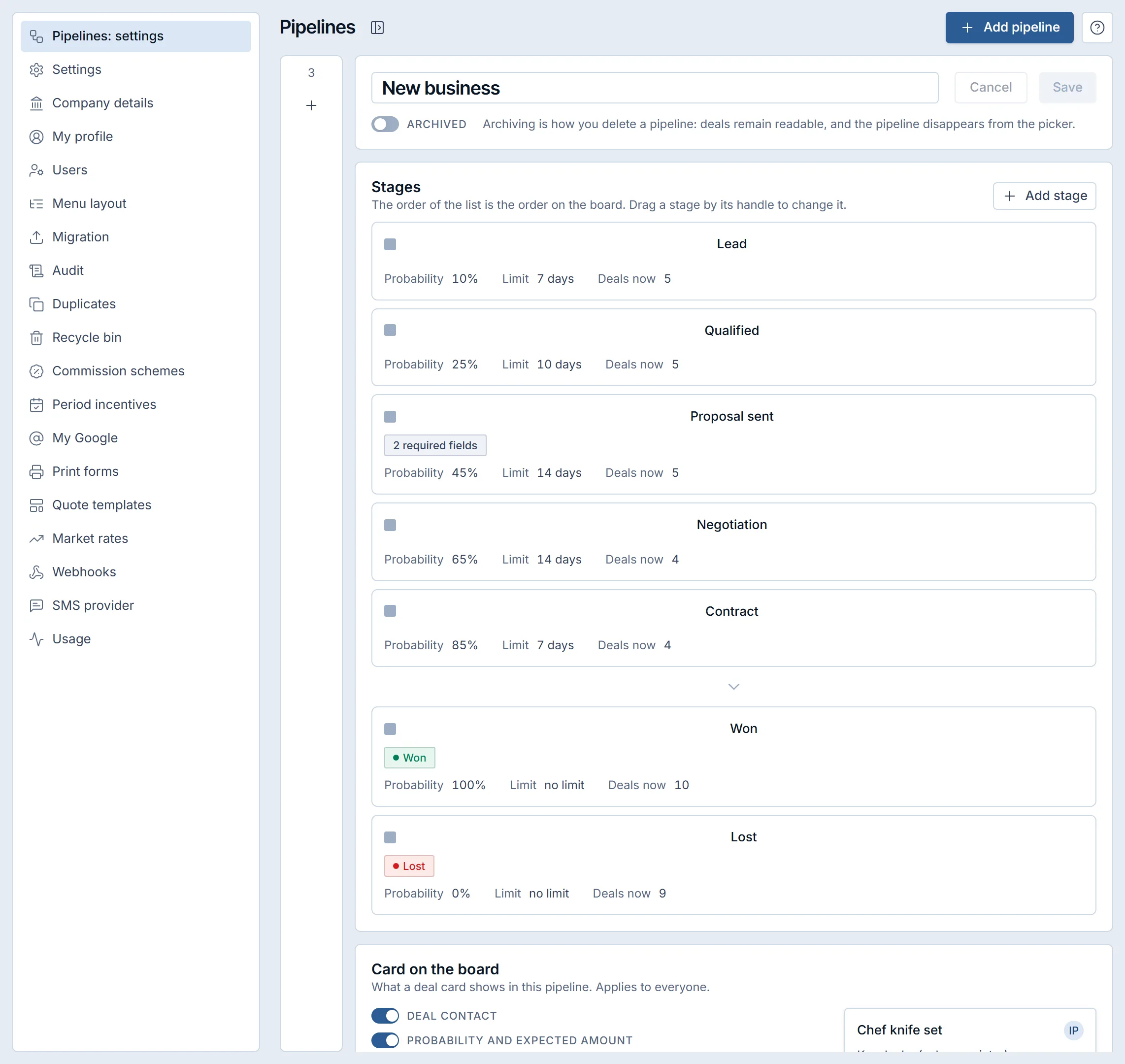
Krokul CRM is a B2B CRM for contract-based companies: deals, projects and profit per client in one system, implemented by integration partners. Two paths start a project. A new company with simple accounting creates a free workspace, answers one question about the type of business and sets up on its own. A company with data, several pipelines or an accounting exchange orders the setup, the team training and the data transfer from an implementation partner.
The partner program has public rules that you can use as questions for any integrator. Partners take a course and an exam in the partner portal, and the certificate belongs to a person, so ask which people on your project hold one. You pay the plan listed on the website with or without a partner, because the partner’s share comes out of Krokul’s revenue and is no markup. Implementation, training, custom work and support are billed by the partner at the partner’s own price, and Krokul takes nothing from those services. The rules for Krokul implementation partners list the terms in full.
Client inquiries reach only partners who passed the course and the exam and run their own company in Krokul. A partner answers an inquiry within one business day, otherwise it moves to the next partner. If the cooperation does not work, you can switch. In company settings, My company, the Your partner block lets an administrator revoke the partner’s access and state a reason, and the partner’s share stops from the next period.
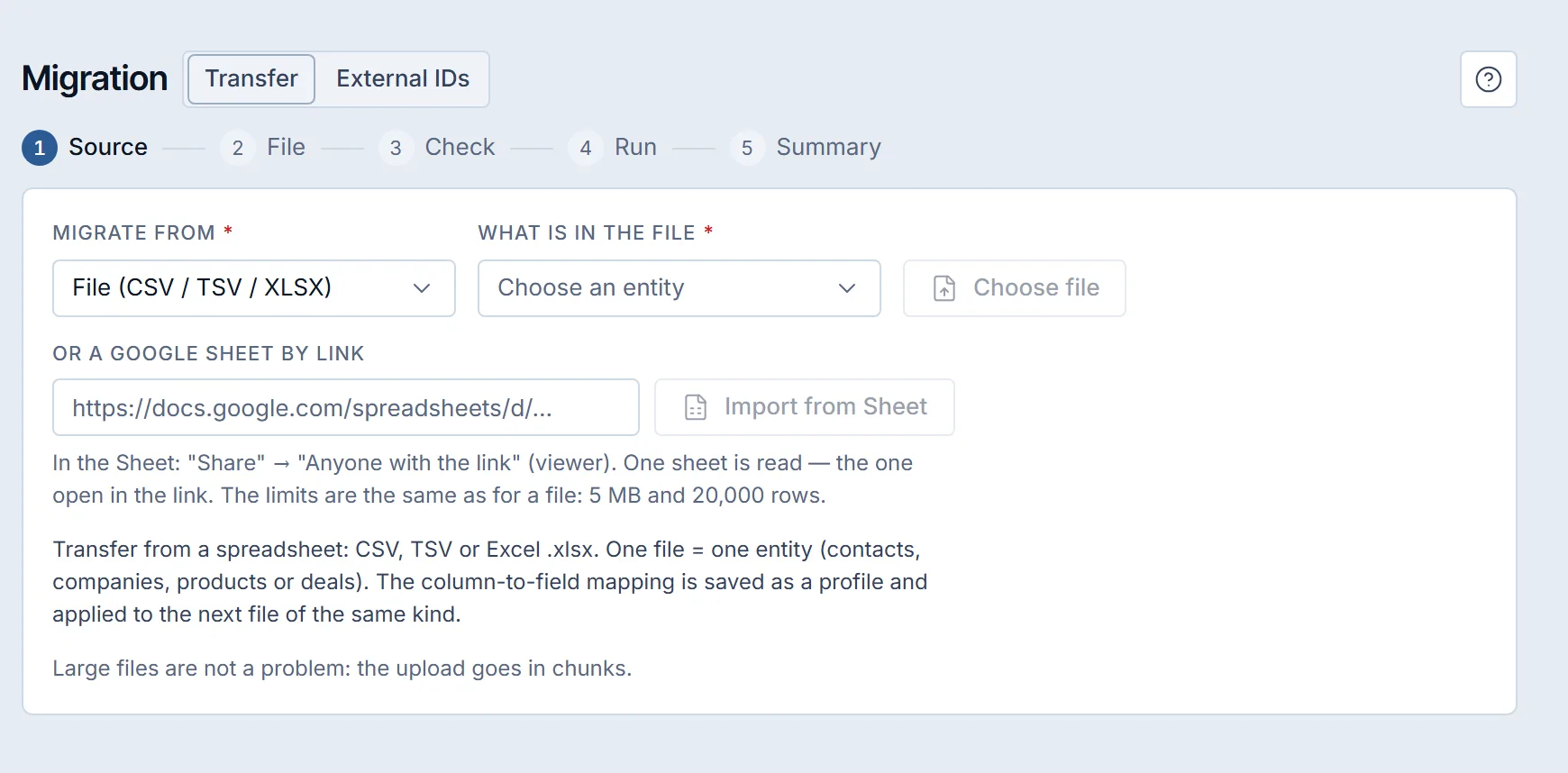
Data migration is a good test of a partner. The Migration screen of Krokul takes a file in CSV, TSV or XLSX format or a Google Sheet by link, and one file holds one kind of record. A trial run writes nothing and reports how many records would be created, updated and skipped, and the live import can still reject some rows because the trial run does not check storage constraints. The Rollback button removes the records created by a live run, so ask the partner to show both in your own data.
A partner who runs its own projects in Krokul sees the same screens as you, including how an integrator in Krokul tracks the hours of a client’s project against the support package you agree on.
Frequently asked questions#
How much does a CRM integrator cost?
The cost is the sum of hours per phase multiplied by the rate, plus the support agreement. Ask each candidate for hours and a rate per phase, so the proposals can be compared line by line.
Can a company set up a CRM without an integrator?
Yes, when the company is new, its accounting is simple and it needs one pipeline. A company with years of data, several pipelines or an accounting exchange gets a better result with a partner who maps the fields and tests the migration.
What is the difference between a CRM vendor and a CRM integrator?
A vendor builds and sells the CRM. An integrator configures it for a client, moves the data, connects other systems and trains the team, and bills for that work.
Can I change my implementation partner later?
Yes, if your contract says so. Write the notice period for the support agreement and the handover of administrator rights into the contract before you sign.