Short answer
Revenue leakage in professional services is the value of work that was delivered or sold and never reached an invoice, shown in money and as a share of what the company earned. To measure it for one closed month, total what was earned from hours, milestones, deals and subscriptions, subtract what was invoiced and divide the gap by what was earned.
- Formula: unbilled value ÷ earned value
- Measure: once a month
- You need: hours, contracts, deals and invoices
On this page
What revenue leakage means in a professional services company#
Revenue leakage in a professional services company is the money you earned by delivering or selling work and never invoiced. It is the subject of the wider guide on billing everything you deliver, and this article gives you the definition and the measurement. A service company sells time and outcomes, so every hour or milestone that skips an invoice is revenue that cannot be recovered later from the client’s goodwill.
Outside surveys show that the loss is common. SPI Research’s 2026 Professional Services Maturity Benchmark puts revenue leakage at 4.5% of revenue. A 2025 survey of 273 US agencies by Ignition, a billing vendor, found that only 1% of agencies invoice all work outside the agreed scope. Use both figures as a reference point, and measure your own number with the method below.
- Revenue leakage
- Revenue leakage is the value of delivered or sold work that never reaches an invoice, expressed in money or as a share of earned value.
- Earned value
- Earned value is the total of what the company could invoice for a period: logged billable hours at their rates, finished contract milestones, won deals and subscription periods that have started.
- Leakage rate
- The leakage rate is unbilled value divided by earned value, shown as a percentage for one period.
- Unbilled work
- Unbilled work is work already delivered or sold for which the client has not yet received an invoice or a completion certificate.
Where revenue leaks in a service company#
Revenue leaks wherever the person who delivers the work and the person who invoices it look at different records. Five places account for most of it, and each one has its own record of delivery. The guide on finding delivered work that was never invoiced shows how to check each place in turn.
| Where it leaks | What happens | What shows it |
|---|---|---|
| Hours above the package | The team logs more hours than the retainer includes and nobody prices the extra | Logged hours minus package hours, with no overage line on a document |
| Closed project month | A month ends with billable hours and no completion certificate or invoice | Billable hours in the month with no document for that month |
| Contract milestone | A stage is finished and accepted, and only part of the stages are invoiced | Finished stage value minus certificates and invoices for it |
| Won deal | A deal is marked won and nobody is told to invoice it | Won deal with no invoice, certificate or project |
| Subscription period | A period starts and its invoice is never sent | Active subscription with a started period and no invoice for it |
Two losses sit beside these and are measured separately. A client who has been invoiced and has not paid appears on the debtor list, and a discount the client agreed to is a price decision. Leakage counts only the work that has no document at all.
How to measure revenue leakage in five steps#
To measure revenue leakage, compare what the company earned in one closed month with what it invoiced for that work, source by source. The five steps below take about an afternoon the first time and less each month after that.
Choose one closed month
Pick a month that ended at least two weeks ago, so late timesheets and slow invoices have already arrived. A closed month gives a number that will not move while you work on it.
Keep the same month for every source, because a rate that mixes periods cannot be compared with the next one.
Total the earned value for each source
For hours, multiply billable hours by the hourly rate in the contract, and count hours above a package at the overage rate. For milestones, take the value of the stages finished in the month. For deals and subscriptions, take the won value and the periods that started.
Mark hours that were not billable at the time of logging, so they stay out of the total.
Subtract what was invoiced for the same work
For each source, add up the invoices and completion certificates dated to that work. Invoices for other work belong in the total of what was invoiced, and they do not reduce a gap in a different source.
The result for each source is its unbilled value. A source with no overage rate on file gets an unknown amount, and you note it as a question for the owner.
Divide the unbilled value by the earned value
Add the unbilled values from all sources and divide the sum by the total earned value. The answer is the leakage rate for the month.
Divide each source on its own as well. The source with the largest share tells you which routine to fix first.
Repeat the measurement every month and by client
Record the rate in the same sheet every month. A falling rate shows that the routine works, and a rising rate shows a new gap, such as a retainer without an overage price.
Split the unbilled value by client at least once a quarter. A few clients usually hold most of the gap, and those are the contracts to rewrite.
Tip. Add lines in the client’s own currency and convert only the total, so a change in the exchange rate never alters a line.
How to calculate the leakage rate for one month#
The leakage rate for a month is the unbilled value divided by the earned value. The example below follows a company that invoiced most of its work on time, and shows how five sources add up to one rate.
| Source | Earned or sold | Invoiced | Unbilled |
|---|---|---|---|
| Hours above the package | £3,400 (40 h at £85) | £2,125 (25 h) | £1,275 |
| Closed project month | £14,400 (180 h at £80) | £12,000 (150 h) | £2,400 |
| Contract milestone | £18,000 | £12,000 | £6,000 |
| Won deal | £5,000 | £0 | £5,000 |
| Subscription period | £3,600 (three periods) | £2,400 (two periods) | £1,200 |
| Work invoiced on time | £160,000 | £160,000 | £0 |
| Total | £204,400 | £188,525 | £15,875 |
Leakage rate = unbilled value ÷ earned value. In the example, 15,875 ÷ 204,400 gives 7.8%. The benchmark above is 4.5%, so this company sits well over it, and the milestone and the won deal hold £11,000 of the gap. Two actions, one certificate and one invoice, would cut the rate to 2.4%.
Which mistakes make revenue leakage look smaller than it is#
- Measuring invoices against last month’s invoices. Every gap then looks normal. Compare invoices with hours, contracts and deals instead.
- Using logged hours alone as earned value. Milestones, won deals and subscription periods sit outside the timesheet, so give each its own line.
- Dropping old items from the total. Work older than a few months is still unbilled, and it needs an owner’s decision between an invoice and a write-off.
- Counting unpaid invoices as leakage. They are receivables, so keep them on the debtor list and out of this number.
- Measuring once a year. A yearly figure hides the month where a retainer lost its overage price, so measure monthly.
A template for the monthly measurement#
Copy the list below into your month-end routine, and keep the results in one sheet with a row per month. The full routine for a service company is in the month-end billing checklist.
- Month measured and the date the measurement was made.
- Earned value for each of the five sources and in total.
- Invoiced value for the same work and in total.
- Unbilled value for each source and in total.
- Leakage rate overall and for the largest source.
- The three clients with the largest unbilled value and the action for each.
How Krokul shows the numerator of the formula#
Krokul CRM is a B2B CRM for contract-based companies: deals, projects and profit per client in one system, implemented by integration partners. Its Unbilled screen under Documents lists the unbilled value that the formula needs on top.
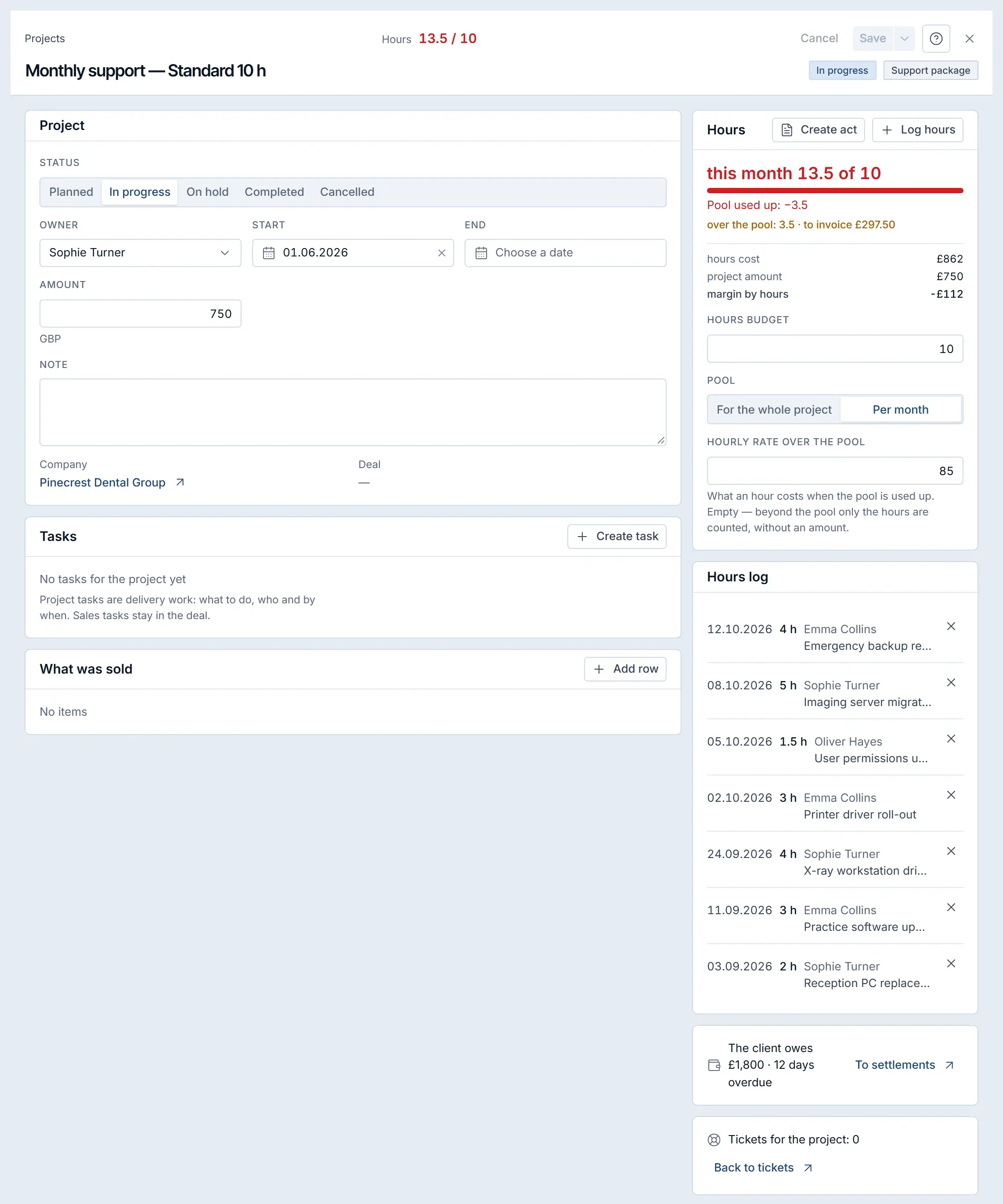
The screen gathers five sources into one list: hours above the package, closed project months, contract milestones, won deals and subscription periods. The header shows the total in the company’s base currency, and five tiles show the amount and the row count for each source. A switch turns the list from rows into clients, with the largest amount first.
Krokul recalculates the list from hours, contracts, deals and subscriptions every time the screen opens, and a row disappears when its document exists. Closed project months are counted for the last three months and won deals for the last 365 days. For the denominator, take the earned value from your own hours and contracts, and divide. Admins and managers see the screen, and the page on project hours and invoicing in Krokul shows where it sits among hours, margin and contracts.
Sources#
- SPI Research, Professional Services Maturity Benchmark, 2026. Revenue leakage at 4.5% of revenue.
- Ignition, survey of 273 US agencies, 2025 (vendor data). Only 1% of agencies invoice all work outside the agreed scope.
Frequently asked questions#
What is a normal revenue leakage rate?
No universal target exists. SPI Research reports 4.5% of revenue as the benchmark figure for 2026, so a rate well above it points to a gap in the invoicing routine. Track your own rate month by month, because the direction matters more than a single reading.
Is revenue leakage the same as bad debt?
No. Revenue leakage is work that never reached an invoice, and bad debt is an invoice that the client never paid. Each one has its own list and its own owner.
Do discounts count as revenue leakage?
Leave them out. A discount is a price the client agreed to, so it belongs in margin analysis. Leakage counts work that has no document at all.
How often should I measure revenue leakage?
Measure it once a month for the closed month, and check hours above a package every week, because that overage grows during the month.