Short answer
To reserve stock for a quote, record the quantity against the client’s deal when the quote goes out and set an end date for the hold. The reservation lowers available stock for every other rep until the date passes or the deal is lost, and the quantity then returns to sale.
- Record: quantity, deal, end date
- Effect: available stock goes down
- Release: on the end date
On this page
When do you need to reserve stock for a quote?#
You need a stock reservation whenever a quote names a quantity of goods and the client needs days to decide. This guide belongs to the topic of selling from stock B2B without overselling and covers the reservation step in detail.
- The quote lists a quantity close to the last pieces on the shelf.
- Two reps quote the same product to two clients in the same week.
- The client needs a board or an approval, so the answer takes a week or two.
- The goods are scarce, and the next receipt from the supplier is weeks away.
- The client asks you to “keep it for us” on a call, and the promise exists only in your memory.
- Stock reservation
- A stock reservation is a quantity of a product set aside for one deal, so that other reps cannot promise the same pieces.
- Available stock
- Available stock is stock on hand minus the quantities reserved for open deals. Available stock is the number a rep may promise.
- Hold-until date
- A hold-until date is the last day a reservation stays in force. After that day the quantity is available to other deals again.
How to reserve stock when you send a quote#
Stock reservation for a quote takes five steps, from checking the shelf to releasing the goods. Every step is a rule that fits one sentence, so the routine takes minutes per quote.
Check available stock before you quote
Open available stock for each product, because stock on hand includes pieces that other deals already hold. Quote only the quantity that is available, and add the date of the next receipt for the remainder.
A rep who quotes from stock on hand promises the same pieces twice.
Reserve the quantity on the client’s deal
A reservation needs an owner, so tie it to the deal of the client and to the line items of the quote. The reserved quantity then always equals what the quote says, and changing the line items changes the hold.
A reservation kept in a spreadsheet or a chat message is invisible to the other reps, so it protects nothing.
Set the hold-until date from the client’s decision time
Ask the client how long the decision takes and add a day for the answer. One to two weeks fits stocked goods, and a few days fits goods that sell fast.
A reservation without an end date holds goods until someone remembers to release them.
Write the hold-until date in the quote
Tell the client that the price and the goods are held until a named day. The date turns “keep it for us” into a commitment that both sides can read, and it gives the client a reason to answer before it passes.
Use the same calendar day in the quote and in the reservation.
Release or extend on the end date
On the end date, ask the client for an answer. When the client agrees, convert the quote into an order and let the shipment replace the reservation. When the client declines or stays silent, let the hold end and the quantity return to sale.
Extend the date only after you check that no other deal needs the same pieces.
How long should a stock reservation last?#
A stock reservation should last as long as the client needs to decide, plus one day for the answer. Longer holds block sales to other clients, and shorter holds force the client to decide before the budget is approved.
| Situation | Hold | Reason |
|---|---|---|
| Fast-moving item, client decides alone | 2 to 3 days | The item sells to others quickly, so a long hold costs revenue |
| Stocked item, client needs one approval | 7 to 10 days | One approval round fits inside the hold |
| Large order, client needs a committee | 14 days | The order is worth a longer hold, with a check on day 10 |
| Scarce item, next receipt in 6 weeks | 5 days, extended once | A hold that long blocks a sale to a client who may buy now |
Treat these periods as a starting point and replace them with the decision times you see in your own deals. A shorter hold with one extension keeps the stock moving.
How does a reservation change available stock?#
A reservation lowers available stock by its quantity from the day it is made until its end date, and the quantity returns on the first day after the end date. The example follows one product with 30 pieces on hand.
| Date | Event | Reserved | Available |
|---|---|---|---|
| 3 Nov | No reservations | 0 | 30 |
| 4 Nov | Quote to client A: 10 pieces held until 12 Nov | 10 | 20 |
| 5 Nov | Quote to client B: 15 pieces held until 20 Nov | 25 | 5 |
| 10 Nov | Client C asks for 12 pieces: offer 5 now and the next receipt date for 7 | 25 | 5 |
| 13 Nov | The hold for client A ended, client A did not answer | 15 | 15 |
The formula is available stock = stock on hand − reserved quantities, so 30 − 10 − 15 = 5 on 5 November. A hold that ends on 12 November stays in force through the whole of 12 November, and the 10 pieces are available again on 13 November. A deal that is lost holds nothing, and goods shipped on a delivery note leave the reservation.
Which mistakes make a stock reservation useless?#
- Reserving without an end date. The goods sit idle after the deal goes quiet; set a date the moment you reserve.
- Reserving by promise on a call. Other reps cannot see it; record the quantity on the deal the same day.
- Holding the full order for a client who needs half now. Reserve what the client has confirmed and quote the rest with a receipt date.
- Extending a hold without checking available stock. A second client may need the same pieces; check first, then extend.
- Ignoring a hold that has ended on a deal that is still open. The deal still promises goods that the warehouse can sell, so reopen the conversation on the end date.
A checklist to copy for every reservation#
- Product and quantity per line of the quote.
- Available stock checked before quoting.
- The deal that owns the reservation, and its account owner.
- Hold-until date as a calendar day, the same in the quote.
- A reminder for the end date.
- What happens on the end date: convert, extend after a stock check, or release.
- Next receipt date for any quantity that is not available.
How to reserve stock for a quote in Krokul#
Krokul CRM is a B2B CRM for contract-based companies: deals, projects and profit per client in one system, implemented by integration partners. A reservation in Krokul comes from the line items of a deal: items of an open or a won deal hold stock, items of a lost deal hold nothing, and sending the quote document does not change the hold.
The hold-until date belongs to the deal and covers the whole order, so there is one date for all lines. In the Items tab of the deal, the reservation control sits at the left of the row above the table, and the label shows “reserved until” with the date. An empty date keeps the hold until the deal is closed.
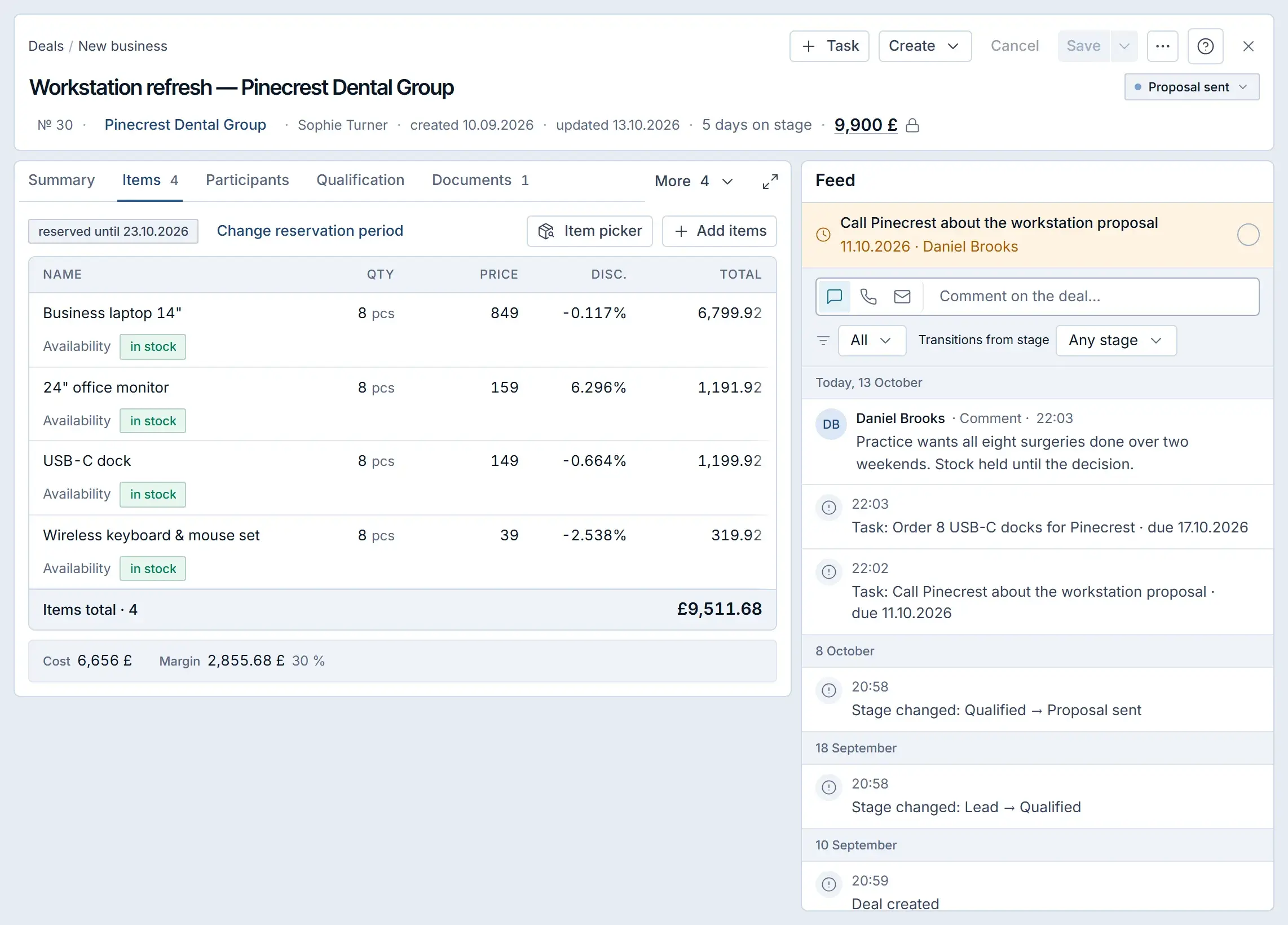
The date is inclusive. A hold until 12 November stays in force through the end of that day in the company’s time zone, and then the quantity returns to available stock with no manual release. When the date has passed and the deal is still open, the deal shows that the reservation expired and that the goods are free again while the deal still promises them.
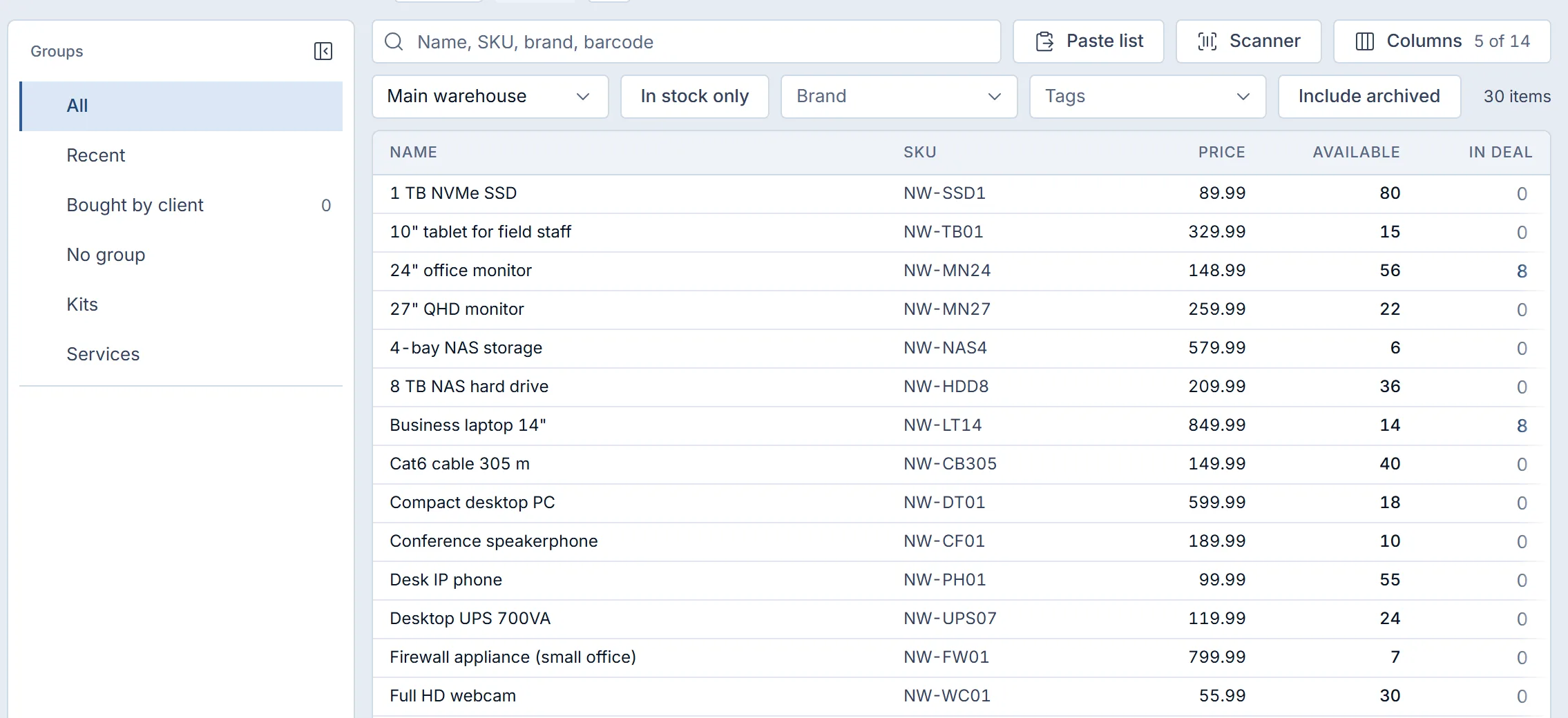
To check availability while you build the quote, open the item picker of the deal. The Available column shows the free stock of the product, and the In deal column shows the quantity this deal already has. A zero in the Available column is greyed out and the picker still lets you add the line, so Krokul shows the shortage and leaves the decision to the rep. The same reserved quantity per product is available through the API. The page on stock levels and reservations in Krokul lists the rest of the stock features.
When the client sends a list of article numbers instead of a quote request, the method for building an order from a SKU list shows how to match it before you reserve. To know what to buy when available stock falls, see how to set reorder points.
Frequently asked questions#
Does sending a quote reserve the goods automatically?
It depends on the system. In Krokul, sending the quote document changes nothing, and the goods are held by the line items of an open deal. Check how your own system links quotes and stock before you rely on it.
Can I reserve more than the available stock?
Check what your system does, because some systems accept the line and some stop it. Krokul accepts the line even when the free quantity is zero, so check the Available column before you promise a quantity.
What happens to the reservation when the deal is lost?
A lost deal holds nothing, so the quantity returns to available stock at once. Mark the deal lost the day the client declines, because an open deal keeps holding the goods.
Should the client know about the hold-until date?
Yes, write the date in the quote. A client who sees the day the goods are released answers earlier, and you have a clear reason to call on that day.
Can I extend a reservation?
Yes, move the end date after you check that no other deal needs the same pieces. Extend once, and release the goods if the client still has no answer.